The answer might be something you can hold in your hand. Print collateral—from a striking business card to a beautifully crafted brochure—offers a tangible way to cut through the digital noise. But knowing where to start and how to design pieces that deliver real return on investment can be a challenge. This guide will walk you through how to strategically plan, design, and produce print marketing materials that build your brand and drive results.
TL;DR: Your Guide to High-Impact Print
- Print builds trust. Physical materials are perceived as more credible and are kept longer than digital ads, creating prolonged brand exposure.
- Match collateral to goals. Use posters for brand awareness, direct mail for lead generation, and catalogs for driving sales.
- Design is non-negotiable. Prioritize visual hierarchy, high-resolution images (300 DPI), and a clear call-to-action on every piece.
- Bridge the digital divide. Use QR codes and custom URLs on print materials to create an interactive, trackable experience for users.
What Is Print Collateral (and Why Does It Still Matter)?
Print marketing collateral is any tangible, printed material used to promote a business, product, or service. This includes common items like brochures, business cards, flyers, direct mail postcards, and sales sheets.
While digital marketing dominates many conversations, print’s power has not faded—in fact, its role has become more focused and impactful.
Print remains relevant because it delivers tangible benefits that digital channels simply can't match.
Tangibility Builds Trust
Physical items feel more permanent and credible than fleeting digital ads. With so much digital noise and misinformation, a physical piece of mail can feel more genuine. According to a 2024 study, 58% of consumers find direct mail trustworthy, and 47% believe it makes an advertiser seem more authentic than digital alternatives. Holding a well-designed brochure or a thick, high-quality business card creates a sensory connection that builds confidence in your brand.
Cuts Through Digital Fatigue
Your customers are tired of staring at screens. Gartner predicts that by 2025, half of all consumers will significantly limit their social media interactions due to a decline in quality and an increase in bots and misinformation. A piece of mail or a leave-behind brochure offers a focused, distraction-free brand interaction. It’s a quiet moment with your brand, away from the noise of notifications and competing browser tabs.
Prolonged Exposure
A social media ad is visible for a few seconds before it disappears from the feed. In contrast, a piece of print collateral has a much longer life. According to 2025 data from JICMAIL, the average piece of direct mail has a lifespan of 7.6 days in a household. That brochure can sit on a desk, a magnet can live on a fridge, and a catalog can rest on a coffee table, providing multiple opportunities for engagement long after it's first received.
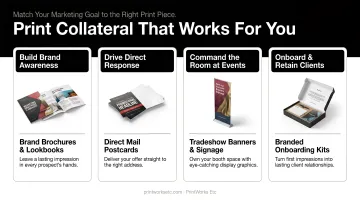
Choosing the Right Print Collateral for Your Marketing Goals
The most effective print collateral isn’t just beautifully designed; it’s strategically chosen to match a specific business objective. Don't just print a flyer because you think you should. Instead, start with your goal and work backward to select the right tool for the job.
For Building Brand Awareness
When your goal is to introduce your brand to a new audience, you need high-visibility materials.
- Place posters and banners in targeted, high-traffic locations. A local restaurant, for example, could use vibrant posters in community centers and nearby businesses to announce its grand opening.
- Give away stickers and decals as a low-cost way to turn customers into brand advocates. A coffee shop could give away branded stickers that end up on laptops and water bottles, spreading brand awareness organically.
For Generating Leads
To capture attention and drive a specific action, your collateral needs to be direct and compelling.
- Go beyond basic contact info on business cards by adding a QR code to your portfolio or a special offer on the back.
- Send direct mail postcards with a focused message and a clear offer. A real estate agent might send postcards to a specific neighborhood with a call-to-action to get a free home valuation.
- Use flyers for events or local promotions. A gym could distribute flyers with a "First Class Free" coupon to encourage sign-ups.
For Nurturing Customers and Driving Sales
When a potential customer is already considering a purchase, you need materials that provide in-depth information to help them make a decision.
- Develop catalogs and lookbooks for businesses with extensive product lines. A furniture company can use a catalog to showcase its collections in beautifully styled rooms, helping customers visualize the products in their own homes.
- Create detailed brochures to explain complex services or high-value products. A B2B software company might create a brochure that details features, benefits, and case studies.
- Equip your sales team with sales sheets—one-page documents that provide the key talking points, specs, and pricing for a specific product or service.
For Fostering Loyalty
Strengthen your relationship with existing customers by making them feel valued beyond the initial sale.
- Send thank-you cards with a handwritten note on branded stationery to leave a powerful, lasting impression.
- Use branded stationery, such as letterhead and envelopes, to reinforce your brand identity in every piece of communication.
- Offer high-quality promotional items like branded journals, calendars, or tote bags that serve as a regular reminder of your brand and show appreciation.
Essential Design Principles for High-Impact Print Materials
Great design separates collateral that gets results from pieces tossed in the recycling bin. Following a few non-negotiable principles ensures your print materials always make an impact.
Establish a Clear Visual Hierarchy
Visual hierarchy is the art of guiding the reader's eye through the design in a deliberate order. You want them to see the most important information first. Achieve this by using:
- Make headlines and key messages the largest elements on the page.
- Use bold, contrasting colors to make your call-to-action or key offer stand out.
- Position critical information where the eye naturally goes first (typically the top or center).
Master Typography and Readability
Your font choices can make or break a design. Stick to two or three complementary typefaces—one for headlines, one for subheadings, and one for body copy. Most importantly, ensure the text is legible. Use a readable font size for body copy (typically 9-12pt for print) and give your text room to breathe with adequate line spacing.
Use High-Resolution Imagery
This is one of the most common mistakes in print design. Web images are typically 72 DPI (dots per inch), which looks fine on-screen but prints blurry and pixelated.
For professional, crisp quality, all images must be at least 300 DPI. Pulling a low-resolution logo from a website is a surefire way to undermine your brand's credibility.
Design with the End in Mind (Bleeds, Folds, and Finishes)
Think about the final physical product from the very beginning.
- Bleed: Extend your design 1/8th of an inch beyond the trim edge. This ensures no accidental white borders appear after cutting.
- Folds: For pieces like tri-fold brochures, plan your layout around the fold lines so no important text or images are creased.
- Paper and Finish: The paper stock impacts the final feel. A thick, matte paper seems modern and premium, while a glossy finish makes colors pop.
Keep Your Branding Consistent
Every piece of collateral is an ambassador for your brand. Use your company's official logo, color palette, and fonts consistently across all materials. This repetition reinforces your brand identity and builds recognition and trust over time.
Craft a Compelling Call-to-Action (CTA)
Don't leave your audience guessing. Every piece of collateral must tell them exactly what to do next. A strong CTA is clear, concise, and action-oriented.
- "Scan to see the full menu."
- "Visit our website for 10% off your first order."
- "Call today for a free, no-obligation consultation."
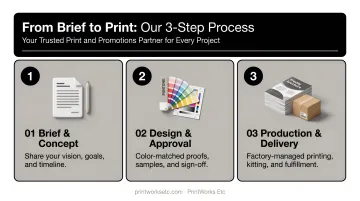
The Designer’s Checklist: From Concept to Production
Bringing a print project to life requires a clear plan. Following a structured process ensures your creative vision is executed flawlessly.
Start with the Creative Brief: Before you open any design software, create a brief that outlines the project's core components: its primary goal, the target audience, the key message you need to convey, the call-to-action, and the budget. A clear brief is your roadmap for the entire project.
Design and Proofing: Once the design is complete, the proofing stage is crucial. Get multiple people to review the proof. Check for typos, grammatical errors, and incorrect contact information. Verify that colors look correct and that all images are sharp. A small mistake caught here can save you from a very expensive reprint.
Partner with a Print Expert: The final step is production. This involves technical details like paper sourcing, color matching, and managing factory logistics—often the most stressful part of the process for designers.
Partnering with a print procurement specialist can simplify this stage. An expert partner like PrintWorks Etc acts as a single point of contact, handling vendor management and quality control so you can focus on strategy.
Integrating Print and Digital for a Cohesive Brand Experience
Print and digital marketing aren't competitors; they are powerful partners. When used together, they create a seamless and cohesive brand experience that meets customers wherever they are. The widespread use of QR codes on print advertisements is a perfect example of this hybrid approach, seamlessly connecting physical media to digital assets.
Here are a few ways to bridge the gap:
- Use QR Codes: A QR code on a flyer, poster, or business card can instantly direct a user to a specific landing page, a promotional video, or your social media profile. This makes your print material both interactive and trackable.
- Drive Online Traffic with Direct Mail: Send a postcard with a unique promo code that can only be redeemed on your e-commerce site. This tactic incentivizes online visits and allows you to measure the mailer's direct sales impact.
- Promote Digital Assets in Physical Spaces: Use in-store signage, table tents, or packaging inserts to encourage customers to sign up for your newsletter, follow you on social media, or download your mobile app.
Frequently Asked Questions
What is printed marketing collateral?
It refers to any tangible, printed materials used for promotion. Common examples include brochures that detail services, business cards for networking, and flyers used to announce local events or sales.
How do you measure the effectiveness of print marketing?
Track print effectiveness by adding unique digital bridges to your materials, such as campaign-specific QR codes or dedicated URLs. These allow you to monitor online engagement and attribute conversions directly to your print campaign.
What are the most common mistakes to avoid in print design?
The three biggest pitfalls are using low-resolution images (always use 300 DPI), overcrowding the design with too much text or too many elements, and forgetting a clear, compelling call-to-action that tells the reader what to do next.
How do I choose the right paper and finish for my project?
Your paper choice affects brand perception. Heavier stock feels more premium, while the finish sets the tone—glossy is best for vibrant photos, and matte or uncoated finishes offer a modern, sophisticated feel.
What's the difference between digital and offset printing?
Digital printing is ideal for small, fast, or personalized jobs like direct mailers with variable data. Offset printing uses plates and is more cost-effective for large, static runs, typically offering superior color consistency.
Can print collateral be environmentally friendly?
Absolutely. You can opt for paper certified by the Forest Stewardship Council (FSC) or choose stocks with high recycled content. Using soy-based inks is another eco-friendly alternative to traditional petroleum-based inks.