The cost of custom business cards ranges widely: from roughly $0.04 per card for bulk budget orders to $0.57 or more for specialty finishes and premium stock. That spread makes it easy to overspend or underspend without clear guidance on what actually drives the price.
This guide breaks down current pricing across quality tiers, the key factors that move costs up or down, and a practical framework for matching your budget to your actual business needs.
Key Takeaways
- Custom business cards range from roughly $0.04 to $0.57+ per card depending on stock, finish, and quantity
- The four biggest cost drivers: paper weight, finish type, quantity, and whether you need design support
- Budget buyers can expect ~$25 for 500 standard cards; premium specialty options for 500 cards can run $100–$250+
- Premium cards pay off for high-value client relationships; standard cards are the right call for high-volume giveaways
How Much Do Custom Business Cards Cost?
No two business card quotes look the same. Identical-looking cards can carry very different price tags depending on the printer, stock weight, finish, and order size. Knowing those variables upfront keeps you from overpaying — or underpaying in ways that hurt your brand.
Two mistakes come up constantly:
- Buying the cheapest cards available without considering how they'll represent your brand
- Over-specifying premium finishes for cards handed out at trade show booths, where most end up in a bag and never get looked at again
Typical Cost Ranges by Quality Tier
| Tier | 500-Card Price | Per-Card Cost | Best For |
|---|---|---|---|
| Budget / Basic (14pt, single or double-sided, no specialty finish) | ~$25 | ~$0.05 | High-volume giveaways, startups, secondary touchpoints |
| Mid-Range / Standard (16pt, double-sided, matte or gloss) | ~$40–$65 | ~$0.08–$0.13 | Most small businesses and professionals wanting quality without specialty finishes |
| Premium / Specialty (18pt–32pt, spot UV, foil, soft-touch, embossed) | $100–$250+ | $0.46–$0.57+ | High-end client-facing professionals, luxury brands, where the card itself signals quality |
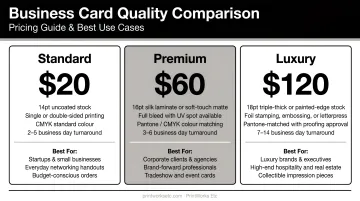
Budget tier example: GotPrint lists 500 standard 14pt full-color cards at $24.85, or about $0.05/card. Staples matches this at $24.99 for 500.
Premium tier example: MOO's Raised Spot Gloss cards on 18pt paper start at $51 for 50 — that's $0.565/card at 1,000 cards. UPrinting's Raised Foil cards run $116.13 for 250, or about $0.46/card.
Cost by Quantity: Per-Card Breakdown
Volume discounts are real — and the math moves fast. Larger orders cost more total but far less per card.
| Quantity | Approximate Price | Per-Card Cost |
|---|---|---|
| 100 | ~$14.99 | ~$0.15 |
| 250 | ~$22–$32 | ~$0.09–$0.13 |
| 500 | ~$25–$33 | ~$0.05–$0.07 |
| 1,000 | ~$40 | ~$0.04 |
The per-card cost at 1,000 cards can be less than half what you'd pay at 100. If your design is locked, ordering more upfront is the straightforward move.
Key Factors That Affect Custom Business Card Pricing
Final pricing is shaped by a combination of technical specifications and production choices. Knowing what drives each cost line helps you avoid surprises when you configure an order.
Paper Stock and Weight
Paper thickness is measured in points. The difference between 14pt and 18pt isn't just about durability — it's the first thing someone notices when they pick up your card.
- 14pt — Standard; thinner feel, adequate for basic needs
- 16pt — Premium; noticeably heavier, what most quality-conscious buyers choose
- 18pt — Premium Plus; substantial feel, often paired with specialty finishes
- 32pt — Ultra-thick; comparable to a credit card in weight, reserved for luxury applications
To put the price difference in real terms: on MOO's platform, moving from 16pt Original ($23/50) to 18pt Super ($33/50) is a 43% price increase. Moving to 32pt Luxe ($43/50) is an 87% increase over the 16pt baseline. These are same-vendor comparisons — actual percentages vary by printer.
Finish and Coating Type
Coating choice affects both how the card looks and how much it costs. Here's how common options stack up:
| Finish | Relative Cost | Notes |
|---|---|---|
| Matte | Low | Non-reflective, sophisticated; great for text-heavy designs |
| Gloss | Low | Enhances color vibrancy; better for image-heavy designs |
| Soft-Touch | Moderate | Velvety feel; pairs well with minimal design aesthetics |
| Spot UV / Raised Spot Gloss | High | Selective gloss over matte base; MOO's version runs ~122% more than standard at 50-card quantities |
| Foil Stamping / Raised Foil | High | UPrinting's raised foil at 250 cards is ~262% more than standard cards at the same quantity |
| Embossing | High (quote-dependent) | Creates raised 3D elements; pricing varies by vendor and complexity |
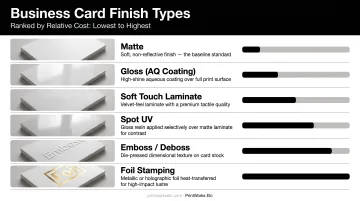
Matte vs. gloss alone often doesn't change the price — Staples lists both at $21.99 for 250 standard cards. The real cost jump comes from specialty treatments.
Card Size, Shape, and Material
Standard 3.5" x 2" cards are the most economical option by a wide margin. Departing from that changes the math fast.
- Die-cut shapes (leaf, circle, oval, etc.): Examples range from $0.35 to $0.58/card at 250 quantities — compared to $0.13/card for standard stock at the same quantity
- PVC / Plastic cards: 48HourPrint lists 100 plastic cards at $68.01 — roughly 4.5x the cost of standard 100-card paper orders
- Metal cards: Volume pricing from LogoTags runs $0.96–$1.54/card, or roughly 19x a basic paper card at comparable quantities
- Wood cards: Cards of Wood prices 100 cards at $37 ($0.37/card) — several times the paper equivalent
A real estate agent or private wealth advisor handing out a metal card makes a very different first impression than a flimsy 14pt card. For high-trust, relationship-driven businesses, that premium is usually justified.
Design Costs
Design is a separate line item from printing, and it's one that catches many buyers off guard.
- Free online templates (VistaPrint, Canva, etc.): $0 to ~$50; fast but potentially generic
- Freelance marketplaces (Fiverr, Upwork): Listings start from $5–$30; vet portfolios carefully before ordering
- Designer marketplaces (99designs): Contest packages start at $199; full project estimates range $169–$399
- Small business custom design: VistaPrint's 2024 cost guide puts this range at $199–$999 for quality custom work
- Agency or branding package: $2,500+ for comprehensive brand work including business card design
PrintWorks Etc builds layouts with the actual manufacturing process in mind — so files are production-ready from the start, not corrected at the last minute before press. That distinction saves time and avoids costly reprints.
Turnaround Time and Shipping
Standard 5–7 business day production is the most cost-effective choice. Rush options exist but carry a premium.
- Staples offers same-day pickup for orders placed before 12 pm
- UPrinting offers turnaround as fast as 1 business day with rush selection
- GotPrint's rush production starts at 2 business days
On shipping, Staples' specialty business card page lists delivery at $8.99 standard, $19.99 date-specific, and $29.99 for fastest expedited. Free ground shipping kicks in at $59.99+ on qualifying orders. For small orders, shipping can represent a meaningful percentage of total cost — worth factoring in when comparing printer quotes.
Full Cost Breakdown: Beyond Just the Print Price
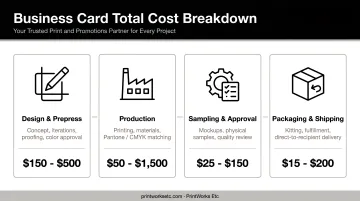
Many buyers focus only on the per-card price and are surprised when the total invoice is higher. A complete business card budget has four components:
Design and file preparation — One-time cost. Free with templates; $75–$450+ with a professional designer. This is where brand perception starts, and the investment pays off on client-facing materials.
Printing and finishing — The variable core: per-card cost × quantity, plus any add-ons for premium stock, specialty coatings, double-sided printing, or custom shapes. This changes most based on spec choices.
Proofing — Digital proofs are typically free; reputable printers require approval before production begins. Physical color proofs for precise color matching start at approximately $40. Worth the cost for large orders, specialty finishes, or any job where color accuracy is brand-critical.
Shipping and handling — Ranges from free (local pickup or minimum spend thresholds) to $30+ for expedited delivery. For small orders, rush shipping can equal or exceed the printing cost itself. When comparing vendor quotes, include the shipping line — the lowest print price doesn't always win once delivery costs are added.
Budget vs. Premium Business Cards: What's the Real Difference?
Both options have legitimate use cases. The right choice depends on who receives the card and what impression it needs to make.
| Dimension | Budget (14pt, standard finish) | Premium (16pt–32pt, specialty finish) |
|---|---|---|
| Print quality | Adequate color reproduction | Richer color depth, sharper detail |
| Paper feel | Thin; bends easily | Substantial; doesn't flex in hand |
| Finish impression | Flat or basic gloss | Tactile interest: velvet, foil, raised texture |
| Design flexibility | Template-constrained | Full custom layout, shape, material |
| Brand perception | Functional | Signals care, quality, and investment |
The ROI case for premium cards is straightforward: a 2018 FedEx Office survey found that nine in ten consumers agreed that the quality of printed materials indicates the quality of service provided by a business. If a new client relationship is worth thousands of dollars, spending an extra $0.30 per card — roughly $150 more for 500 — is a strong ROI decision.
The calculus shifts, though, when volume is the priority. Premium finishes don't belong on cards that will be piled in a bowl at a trade show registration desk. High-volume distribution calls for cost-efficient options; selective, high-stakes distribution is where premium cards earn their cost.
How to Estimate the Right Budget for Your Business Cards
The right budget isn't about spending as little as possible — it's about matching card quality to context.
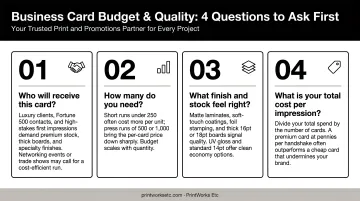
Use these four questions to calibrate your spec:
What's the average lifetime value of a new client? The higher it is, the more a premium card is justified. A luxury real estate agent, private banker, or entertainment executive should be handing out something that feels intentional.
How frequently will you distribute these cards? High-volume giveaway events favor cost-efficient standard stock. Selective distribution at key meetings allows for premium options without breaking budget.
How does your brand position itself? Your card should reflect your brand tier. A premium service charging premium prices shouldn't hand out a flimsy card — that disconnect registers immediately.
Do you have print-ready artwork? If yes, you can budget primarily for print. If not, factor in design support — either through a freelancer or a print partner with in-house creative capability.
PrintWorks Etc removes the guesswork from that process. The team draws on decades of print production experience and sources through both domestic and overseas vendors to match spec to budget. Project management covers design iteration, material selection, color approval, and delivery.
That guidance matters most when evaluating finish options — the difference between a spot UV treatment that looks intentional and one that looks overdone comes down to experience.
Common Budget Mistakes to Avoid
- Choosing the cheapest option without considering how the card represents your brand
- Ordering too few cards — small quantities cost more per unit and often trigger repeat shipping charges as you reorder
- Over-specifying finishes for cards that won't be distributed selectively
- Ignoring design costs until after printing is already quoted — design is part of the project budget, not an afterthought
Frequently Asked Questions
How much should it cost to print 100 business cards?
Expect to pay around $15–$25 for 100 standard business cards, depending on paper stock and coating choices. VistaPrint's standard cards run $14.99 for 100. Per-card cost is highest at low quantities — ordering 500 at once typically cuts the per-card rate by more than half.
Does paper thickness really affect business card price?
Yes — it's one of the biggest cost drivers. Moving from 16pt to 18pt paper on MOO's platform adds 43% to the price; 32pt adds 87%. The jump in perceived quality is real and noticeable, but it's worth evaluating against how selectively you'll distribute the cards.
Is it cheaper to print business cards in bulk?
Significantly. The per-card cost at 1,000 cards can be less than half the cost at 100. If your design is finalized and won't need frequent updates, ordering a larger quantity upfront is almost always the better financial decision.
What's the difference between matte and gloss business card finishes?
Gloss enhances color vibrancy and suits image-heavy or photography-focused designs. Matte offers a non-reflective, sophisticated feel that works well for text and logo-focused layouts — and at most vendors, the choice between them doesn't affect the price on standard cards.
Should I design my own business cards or hire a professional?
Free templates work for simple, low-stakes needs. For client-facing businesses, professional design ($199–$450+ flat rate for most freelance and marketplace options) is worth the investment — generic templates are immediately recognizable, and no amount of print quality fixes a forgettable layout.
What information should be on a business card?
Cover the essentials: name and title, company name and logo, phone number, email, and website. A QR code linking to your website or portfolio is a useful addition. Avoid overcrowding — white space improves readability and makes the card feel intentional rather than desperate.