Direct mail has re-emerged as a trusted, high-performance channel in healthcare. But every piece that touches patient information must meet strict legal standards. Get it wrong, and you're not just looking at an ineffective campaign — you're looking at potential HIPAA violations.
This guide covers what healthcare marketers need to know: compliance requirements, print and packaging formats, campaign best practices, and how to choose the right production partner.
Key Takeaways
- Direct mail generates response rates of 11–25%+ in healthcare — significantly outperforming most digital channels
- Any mail piece containing Protected Health Information (PHI) falls under HIPAA's Privacy Rule
- Print vendors handling PHI must sign a Business Associate Agreement (BAA) before production begins
- QR codes, PURLs, and tracked phone numbers tie physical mail to measurable response data — making attribution straightforward
- A specialized print partner reduces compliance risk and operational burden for lean healthcare marketing teams
Why Direct Mail Still Delivers in Healthcare
The Numbers Make the Case
USPS research on healthcare direct mail found that 23% of health businesses reported response rates of 11–15%, and 16% reported rates above 25% — making healthcare the sector most likely to hit the highest response tier. For context, the average direct mail response rate across all industries sits around 9%.
That gap matters. Appointment reminders, preventive care outreach, and health plan communications are time-sensitive. A channel that actually gets opened and read is worth the investment.
The Trust Factor
Physical mail carries credibility that digital channels struggle to replicate. Lob's 2025 consumer research found:
- 84% of consumers read direct mail immediately or the same day
- 49% view brands that use mail as more credible
- 44% find physical mail more authentic than digital communications
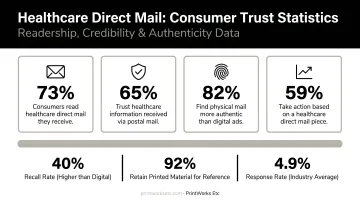
For sensitive health topics — a cancer screening reminder, a mental health resource, a billing statement — that credibility matters. A physical envelope signals seriousness and care in a way that an email in an overcrowded inbox simply doesn't.
Healthcare Use Cases for Direct Mail
Direct mail serves a wide range of healthcare communication goals:
- Appointment reminders and preventive care outreach (flu shots, screenings, annual checkups)
- New service announcements — specialty expansions, new locations, telehealth offerings
- Billing statements and insurance plan updates — enrollment windows, benefit changes, coverage notices
- Patient education materials — discharge instructions, medication guides, condition management resources
Each of these use cases carries its own compliance considerations — HIPAA requirements, required disclosures, and format standards that vary by message type and audience.
HIPAA Compliance: What Healthcare Organizations Must Know
What Counts as PHI in a Direct Mail Context
Under 45 CFR 160.103, Protected Health Information is individually identifiable health information in any form — including paper mail. A printed piece contains PHI when the recipient can be identified and the content relates to their health condition, treatment, or payment for care.
Practical examples of PHI in direct mail:
- Patient name + health condition or diagnosis
- Appointment details tied to a treatment type
- Prescription refill reminders
- Billing or payment information
- Insurance member IDs or health plan beneficiary numbers
- Care-gap messages referencing specific conditions
HIPAA's Privacy Rule governs PHI in all forms. The Security Rule's physical safeguards apply where electronic PHI is received, stored, or processed before printing, meaning your print vendor's facility and data systems are in scope too.
Covered Entities and Business Associates
The compliance obligation doesn't stop at your organization's door. Any vendor that handles PHI on your behalf — including print and mail service providers — qualifies as a Business Associate under HIPAA. That means they must sign a Business Associate Agreement (BAA) before receiving any patient data.
Under 45 CFR 164.504(e), a valid BAA must include:
- Permitted and prohibited uses of PHI
- Required safeguards during production
- Breach notification procedures
- Subcontractor flow-down requirements
- PHI return or destruction at project end
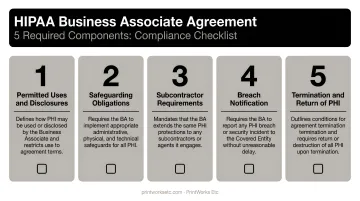
OCR fined Raleigh Orthopaedic $750,000 for transferring PHI of 17,300 patients to a vendor without a BAA in place. Healthcare organizations are responsible for verifying these agreements exist before any patient data changes hands.
Key Rules to Follow During Production
Minimum Necessary Principle — Under 45 CFR 164.502(b), only include PHI that's strictly required for the mailing's purpose. An appointment reminder needs the patient's name and appointment time — not their full medical history.
Physical safeguards include:
- Envelope design that prevents PHI from showing through windows or on exterior surfaces
- Secure print facility access controls
- Restricted data handling during production
- Quality review before mailing
Current HIPAA civil monetary penalties (adjusted January 2026) range from $145 per violation for unknowing violations up to $2,190,294 annually for willful neglect that goes uncorrected.
Proper vendor selection and documented processes are the operational defense against that exposure. A signed BAA, a vetted print partner, and a documented minimum-necessary review are what regulators expect to see.
Types of Healthcare Compliance Print and Packaging Materials
Direct Mail Formats by Use Case
Different healthcare communications call for different formats:
| Format | Best For |
|---|---|
| Postcards | Appointment reminders, preventive care campaigns, quick announcements |
| Letters / brochures | Plan updates, new service introductions, detailed policy information |
| Folded mailers | Multi-service messaging, health plan enrollment, complex benefit explanations |
| Dimensional mailers | New patient welcome, high-priority outreach where stand-out matters |
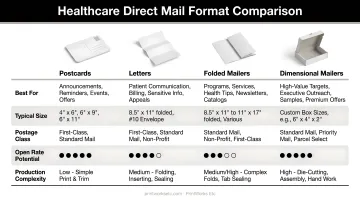
Patient Education and Compliance Packaging
Healthcare compliance extends well beyond direct mail. Physical packaging — patient welcome kits, discharge instruction packets, prescription inserts, and medication packaging — must comply with applicable regulations while remaining accessible to patients.
Well-designed materials genuinely affect outcomes. CMS plain language guidelines exist for a reason: readability directly determines whether patients follow discharge instructions, attend follow-ups, and manage their conditions.
Branded materials — clinic welcome kits, health plan enrollment packages, intake packets — reinforce organizational credibility and build trust at a moment when patients may be anxious or uncertain.
Accessibility and Internal Print Materials
Under the ADA, covered entities must communicate effectively with people who have vision, hearing, or speech disabilities. For print materials, that means:
- Appropriate font sizes for older patient populations
- Plain language that avoids medical jargon
- Multilingual versions where required by patient demographics
Internal materials deserve the same production quality as patient-facing pieces. HIPAA training handbooks, procedure manuals, policy updates, and staff onboarding packets all benefit from professionally produced, consistently branded output — particularly for multi-site healthcare organizations.
PrintWorks Etc templates are built to avoid PHI by design — a practical advantage for high-volume compliance print programs. The firm produces patient education materials, intake packets, referral cards, facility signage, and branded comfort items for hospice, palliative care, home health, hospital, behavioral health, and senior living clients.
Best Practices for Running a Compliant Healthcare Direct Mail Campaign
Segment Your Audience Before You Mail
Effective campaigns start with precise segmentation. Divide recipients by care stage, appointment history, demographics, or health interests — segmentation improves relevance and reduces compliance risk by ensuring appropriate messages reach appropriate recipients.
Under 45 CFR 164.501, using PHI for marketing generally requires patient authorization. Treatment communications, care coordination, and descriptions of services provided by the covered entity may fall outside that requirement — but the boundaries depend on the specifics. When in doubt, consult your compliance team before building segmented lists from PHI.
For new patient acquisition, use non-PHI lists based on geography or demographics only.
Write with Clarity and a Strong CTA
Healthcare recipients may be anxious or managing difficult health situations. Clear, empathetic messaging builds trust more effectively than dense clinical copy.
Every mail piece should:
- Immediately communicate what it is and why the recipient received it
- Use plain language free of unnecessary jargon
- Include a specific, visually prominent call to action — schedule an appointment, call this number, visit this URL
Tracking-enabled CTAs — unique phone numbers, QR codes, and personalized URLs (PURLs) — do two things at once: they guide recipients toward a clear next step while giving your team measurable performance data.
Build and Maintain a Clean, Compliant Mailing List
List quality affects both performance and compliance. Outdated or inaccurate records waste budget — and in healthcare, mailing to the wrong person creates real privacy risk.
Best practices:
- Run lists through USPS NCOALink (approximately 160 million change-of-address records) before each mailing
- Apply deceased suppression for patient-facing lists
- Confirm proper patient consent documentation for PHI-based lists
- Remove outdated records — USPS Move Update requires address updates within 95 days of mailing for presorted mail
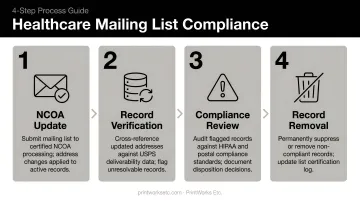
Track Results and Optimize
Track the metrics that connect mail activity to real outcomes:
- Response rates and conversion rates (appointments booked, calls made)
- QR code scan rates by segment or geography
- PURL visits and time-on-page
- ROI relative to cost per piece mailed
Run A/B tests on headlines, formats, or CTAs to improve over time. A postcard format that outperforms a letter in one care category may underperform for a different patient segment. Test before scaling.
Integrating Direct Mail with Digital Channels
Combining direct mail with digital channels produces measurably better results. USPS found that adding direct mail to digital campaigns more than doubled overall revenue compared with purely digital campaigns alone.
Practical integration tactics:
- QR codes linking to appointment scheduling portals or custom landing pages
- PURLs providing personalized web experiences based on recipient data
- Follow-up emails reinforcing the mail message within 48–72 hours of delivery
One important caveat: any digital touchpoint linked from a mail piece must itself be HIPAA-compliant if it collects or displays PHI. HHS OCR's online tracking guidance confirms that patient portals and appointment scheduling pages can involve PHI — and any tracking technology vendor processing that data must also sign a BAA.
That compliance groundwork also unlocks one of the stronger business cases for integrated campaigns: attribution. By tracking which recipients scanned a QR code, visited a PURL, or called a tracked number, marketing teams can directly connect mail campaigns to booked appointments and justify the spend.
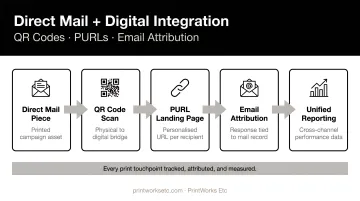
Choosing the Right Print and Packaging Partner for Healthcare
Not every print vendor is equipped for healthcare work. When evaluating partners, ask:
- Do they have a clear process for executing BAAs before production begins?
- How is PHI handled and stored during production?
- What security standards or certifications do they hold (SOC 2, HITRUST, or equivalent)?
- Can they manage the project end-to-end — from design through postal delivery?
- Have they worked with healthcare organizations before, and can they speak to HIPAA-aware production practices?
For healthcare organizations without large in-house print or compliance teams, the value of a single-point-of-contact partner is significant. Rather than managing multiple vendors — a designer here, a printer there, a mail house somewhere else — one partner absorbs the complexity.
PrintWorks Etc handles concept-to-completion execution for healthcare clients — from patient education materials and intake packets to facility signage, bereavement materials, and direct mail campaigns. Their healthcare experience includes:
- Hospice and palliative care
- Home health agencies and hospitals
- Behavioral health organizations
- Dental and orthodontic practices
- Senior living communities
For Unity Hospice and Palliative Care, PrintWorks delivered a comprehensive print and promotional program, shipped ahead of schedule and under budget.
For lean healthcare teams managing sensitive materials and tight deadlines, that kind of end-to-end accountability removes real operational risk.
Frequently Asked Questions
What is HIPAA-compliant direct mail and why does it matter?
HIPAA-compliant direct mail follows specific privacy and security requirements when mailing anything containing Protected Health Information. It ensures patient data is handled lawfully throughout the print and mailing process — from data file receipt through production, delivery, and disposal.
Do healthcare organizations need a BAA with their print vendor?
Yes. Any vendor that creates, receives, maintains, or transmits PHI on behalf of a covered entity — including print and mail service providers — must sign a BAA. The agreement must cover safeguards, permitted uses, breach notification obligations, and PHI destruction when the relationship ends.
What direct mail formats work best for healthcare patient outreach?
Postcards work well for appointment reminders and quick campaigns due to their immediacy. Letters and brochures suit detailed plan or service information. Folded mailers handle multi-service messaging in a single piece. Format choice should match the complexity and sensitivity of the message.
How can healthcare direct mail connect to digital marketing channels?
QR codes, PURLs, and unique tracked phone numbers printed on mail pieces link recipients to scheduling portals, landing pages, or call centers — creating a measurable omnichannel experience. Every digital channel that collects PHI must also meet HIPAA standards — including the vendors behind those tools.
What should patient education packaging include?
It should contain only the PHI necessary for care, use plain language, comply with applicable labeling regulations, and reflect the organization's brand in a way that builds trust. Accessibility details — font size, reading level, multilingual options — directly determine whether patients can act on what they receive.
Can small healthcare practices benefit from direct mail campaigns?
Direct mail is highly scalable — small practices can run targeted, cost-effective campaigns using geographically segmented lists, simple postcard formats, and a print partner that handles production logistics end-to-end. Compliance requirements are identical regardless of practice size, which is precisely why a knowledgeable partner matters most for smaller teams with fewer internal resources.