Introduction
Most businesses pour their marketing budget into digital — paid ads, email campaigns, social content — and treat print as an afterthought. That's a costly gap. The physical materials sitting in a prospect's hands during a sales meeting, arriving in their mailbox, or displayed at a trade show booth often do more to close a deal than a retargeted ad.
Print collateral is the category of physical, printed materials a business uses to build awareness, support sales, and communicate with customers. This guide breaks down what it is, the main types with real examples, and how to decide which formats are right for your goals — so you're investing in the formats that actually work for your goals, not just filling a brochure rack.
Key Takeaways
- Print collateral = any physical printed material used to market a brand, support sales, or communicate with customers
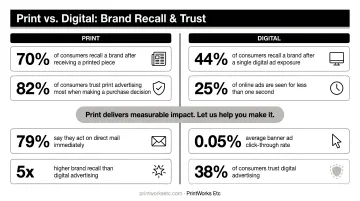
- Physical materials drive 75% unaided brand recall vs. 44% for digital — far ahead of most digital formats
- The four main categories: marketing/awareness materials, sales support collateral, direct mail, and event/promotional items
- Right-fit selection comes down to your goal, your audience, and where the piece will be seen
- A full-service print partner handles sourcing, production, and delivery across all four categories
What Is Print Collateral?
Print collateral is the umbrella term for any printed material an organization produces to build brand awareness, support marketing, or assist the sales process. That includes brochures, flyers, business cards, postcards, catalogs, sell sheets, presentation folders, banners, and more.
Two related terms often get used interchangeably, but they're distinct:
- Marketing collateral attracts and nurtures prospects — think flyers, posters, and awareness campaigns
- Sales collateral supports and closes deals — think sell sheets, product catalogs, and presentation folders
Both fall under the print collateral category. Both often work together in the same campaign.
Print differs from digital in one concrete way: it's physical. A printed piece is held, passed around, kept on a desk, or mailed across the country. That tactile quality is why print consistently outperforms digital on memory retention and emotional response — something the next section covers in detail.
Why Print Collateral Still Works
The argument for print isn't nostalgia. It's neuroscience and data.
Research from Canada Post and True Impact found that direct mail required 21% less cognitive effort than digital, produced 75% unaided brand recall versus 44% for digital, and scored 20% higher for motivation.
A separate USPS OIG and Temple University study found physical ads generated stronger emotional responses, better memory encoding, and stronger brain activation associated with purchase value compared to digital ads.
The trust data points the same direction. MarketingSherpa reported that 82% of U.S. respondents trusted print ads in newspapers and magazines when making a purchase decision — more than any other channel tested.
Where Digital Falls Short
Print reaches buyers in moments and places digital ads simply don't:
- Trade shows and conferences — a banner and leave-behind work when there's no screen in the room
- Retail and point-of-purchase — signage and shelf materials influence decisions in the moment
- Direct mail — reaches audiences in a physical space digital ads never touch
- In-person sales meetings — a polished folder says something a PDF can't
The Print + Digital Combination
Print is strongest when it connects to digital. Common integration tactics include:
- QR codes on direct mail — drive recipients directly to landing pages
- Personalized URLs — enable response tracking by individual recipient
- Social handles on event collateral — extend the conversation beyond the event
MarketReach found that 92% of people had been driven online by mail — meaning print drives the first step into a digital funnel.
Types of Print Collateral
Not all print serves the same purpose. The four categories below differ by format, intent, distribution method, and where the audience is in the buying journey.
Marketing and Brand Awareness Materials
This category is designed to introduce your brand, communicate your offerings, and create lasting impressions at high-traffic touchpoints.
Common formats:
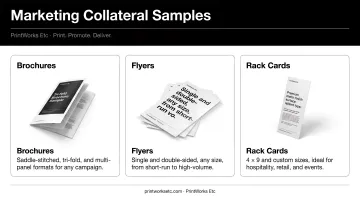
- Tri-fold brochures for service overviews
- Single-page flyers for promotions or events
- Posters for retail environments or trade show booths
- Rack cards for waiting rooms, hotel lobbies, and countertops
- Door hangers and table tents for local or in-venue distribution
Best for: Businesses reaching broad or new audiences — restaurants, healthcare practices, nonprofits, retail stores, and event organizers are frequent users. PrintWorks Etc regularly produces this category of materials for clients across healthcare, hospitality, and construction, where physical presence at point of contact drives awareness better than a digital impression.
Watch out for: These materials are easy to discard. If the design is weak or the value proposition isn't immediately clear, they go straight in the recycling bin. Visual quality and message clarity aren't optional here.
Sales Support and Conversion Collateral
Once a prospect is aware of your brand, this category picks up the work of moving them toward a decision.
Common formats:
- Sell sheets and one-pagers that highlight key features and proof points
- Product catalogs with pricing and full line details
- Presentation folders that organize proposals for a prospect meeting
- Business cards that reinforce credibility in face-to-face interactions
- Lookbooks and brand books for premium or fashion and lifestyle products
Best for: B2B sales environments, consultative selling, and industries with complex or high-value offerings — professional services, real estate, manufacturing, SaaS, and associations. This is where PrintWorks Etc's production capabilities in paper specification, finish options (foil, embossing, soft-touch laminate, spot UV), and color management make a visible difference.
A flimsy business card or a sell sheet printed on the wrong stock communicates the opposite of professionalism. A well-produced presentation folder signals that you pay attention to details — which matters when a prospect is deciding whether to hand you a five-figure contract.
Direct Mail and Outreach Collateral
Direct mail is defined by one key feature: it goes to the audience rather than waiting for the audience to come to it.
Common formats:
- Postcards for seasonal offers and event announcements
- Self-mailers for promotions without envelopes
- Newsletters for client retention and relationship-building
- Personalized letters for nonprofit fundraising appeals
- EDDM (Every Door Direct Mail) for local geographic targeting
- Dimensional mailers for high-value B2B prospects
Best for: Reaching specific geographic or demographic segments, re-engaging lapsed customers, and driving response to a specific offer.
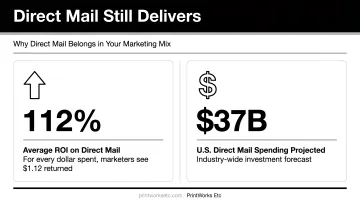
The numbers back it up. According to ANA data from 2022, letter-sized envelopes generated 112% ROI for prospect lists — outperforming both SMS (102%) and email (93%). Winterberry Group projected U.S. direct mail ad spending would rise to $37.3B in 2024, with eight in ten U.S. brands planning to increase direct mail investment in 2025.
What separates direct mail from other print collateral: It requires list management, postal compliance, USPS presort, and fulfillment logistics — none of which are minor. Postage alone accounts for roughly half the cost of a direct mail piece.
PrintWorks Etc handles the full cycle: creative development, list segmentation, variable data printing, mail-prep, USPS presort, and distribution through domestic mail-house partners.
Event, Networking, and Promotional Collateral
This category covers the physical materials that show up in face-to-face settings and keep a brand visible long after the interaction ends.
Common formats:
- Retractable banners and tension-fabric booth walls for trade shows
- Step-and-repeat backdrops and photo walls for events
- Event programs, registration kits, and attendee guides
- Branded notepads, journals, and drinkware left with clients after meetings
- Custom calendars that maintain brand visibility year-round
- Branded merchandise: totes, apparel, tech accessories, and specialty items
Best for: Conferences, trade shows, community events, in-office gifting, and any situation where the goal is lasting brand presence. PrintWorks Etc has executed at major venues including CES, NRF, the LA Convention Center, Anaheim Convention Center, Moscone, and the San Diego Convention Center.
The strategic value of promotional items: A branded item that gets used repeatedly — a tumbler, a notebook, a quality pen — generates ongoing brand impressions at a fraction of the cost of a paid ad. The exposure extends far beyond the event itself. A trade show banner gets seen by hundreds. A branded water bottle gets seen every day for years.
How to Choose the Right Print Collateral
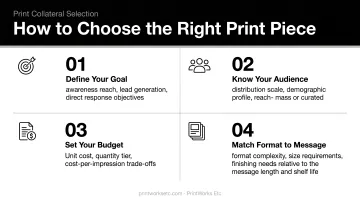
Choosing the right format comes down to four factors — and none of them is "what the competition is doing":
| Decision Factor | Questions to Ask |
|---|---|
| Goal alignment | Awareness, lead gen, sales conversion, or retention? Match the format to the stage. |
| Distribution context | Will it be mailed, handed out, displayed in a storefront, or used at an event? Format and durability requirements differ significantly. |
| Audience specificity | A broad audience needs different materials (flyers, posters) than a targeted list of high-value prospects (catalogs, sell sheets, personalized direct mail). |
| Budget and quantity | Business cards and flyers are cost-effective at low quantities. Catalogs and bound booklets require larger print runs to be economical — quantities can range from a few dozen to tens of thousands depending on format. |
PrintWorks Etc works through this framework with every client. Projects range from 25 copies to 100,000+, with sourcing matched to run length, personalization requirements, and timeline.
Common Mistakes to Avoid
Three errors come up repeatedly in print collateral planning:
Format chosen by habit, not by goal. Many businesses default to brochures when a postcard, sell sheet, or EDDM campaign would better serve the actual objective. Let the goal dictate the format.
Underinvesting in production quality. Inconsistent colors, low-resolution images, and flimsy paper stocks communicate the opposite of what the material is meant to convey. A sell sheet printed on thin, uncoated stock undermines the credibility it's supposed to build. Finishing details — soft-touch laminate, spot UV, proper color management — aren't extras. They determine whether a piece gets kept or tossed.
Treating print as a standalone channel. Materials without a clear call to action, consistent brand identity, or a connection to a follow-up step miss the opportunity to generate measurable results. Every printed piece should tell the recipient exactly what to do next: visit a URL, call a number, scan a QR code, or attend an event.
Conclusion
Print collateral spans a wide range of formats, each serving a distinct purpose across the marketing and sales journey. Knowing which type fits which goal — and executing it well — is what keeps print budgets from going to waste.
The businesses that consistently outperform their competition don't choose between print and digital. They use both. Physical materials build the trust and brand recall that digital struggles to replicate. Digital extends reach and measurability where print has natural limits. Together, they cover more ground than either channel can alone.
If you're not sure which formats are right for your goals, PrintWorks Etc works with clients ranging from Fortune 500 companies to local businesses — managing every detail from concept to delivery. Contact the team to talk through your next project.
Frequently Asked Questions
What does collateral mean in printing?
In printing, "collateral" refers to the physical materials a business produces to support marketing and sales — such as brochures, business cards, sell sheets, and direct mail — as distinct from paid advertising or digital content.
What are the different types of print collateral?
The main categories include:
- Marketing and brand awareness: brochures, flyers, posters
- Sales and conversion: sell sheets, catalogs, presentation folders
- Direct mail and outreach: postcards, self-mailers, newsletters
- Event and promotional: banners, signage, branded merchandise
The right type depends on your audience and objective.
What is print and digital collateral?
Print collateral refers to physical materials, while digital collateral includes assets like landing pages, email templates, and downloadable guides. The most effective strategies combine both — a direct mail piece with a QR code drives someone to a landing page; branded event materials reinforce a digital campaign in person.
What is the difference between marketing collateral and sales collateral?
Marketing collateral — flyers, posters, awareness campaigns — is used to attract and build awareness with new audiences. Sales collateral — sell sheets, presentation folders, catalogs — is used later in the process to support conversations, answer objections, and close deals.
How do I choose the right print collateral for my business?
Start with your goal: awareness, lead generation, sales conversion, or customer retention. Then match the format to where the material will be distributed and who's receiving it. A broad audience calls for different materials than a targeted list of high-value prospects.
Can print collateral work alongside digital marketing?
Print and digital are strongest when integrated. QR codes on direct mail drive landing page visits, personalized URLs enable response tracking on physical pieces, and branded event materials reinforce digital campaigns at in-person touchpoints. Physical materials build trust and recall; digital follow-up captures and converts that interest.