The good news: not all print materials carry the same cost-to-impact ratio. Some formats punch well above their price point, generating brand impressions for months or years from a single print run. Others are best kept lean and targeted. The difference usually comes down to knowing which format serves which goal.
This guide covers the most budget-friendly print materials available today, how to extract maximum value from each print run, and how to match materials to your specific business objectives — whether you're a local restaurant, a real estate professional, or a growing company heading into trade show season.
Key Takeaways
- Business cards deliver one of the lowest costs per impression of any marketing format — essential for networking and first impressions.
- Flyers and postcards are the workhorses of local outreach; EDDM postage runs as low as $0.242 per piece through USPS.
- Brochures give you information density in a compact format, with tri-fold being the most economical fold style.
- Promotional products generate repeated brand impressions over months or years — outerwear alone averages 7,856 lifetime impressions per item.
- A print partner like PrintWorks Etc — who manages vendor sourcing and production — cuts per-unit costs without sacrificing quality.
Why Print Marketing Still Delivers Strong ROI
Physical materials do something digital ads can't: they occupy space. A business card sits in a wallet. A postcard lands on a kitchen counter. A banner greets customers at a booth entrance. That persistent physical presence translates to longer exposure time than any digital ad, which disappears after a scroll.
Trust plays a measurable role too. The numbers across multiple studies point in the same direction:
- Kantar's Media Reactions research found offline ad channels averaged 20% consumer trust versus 11% for online formats — nearly double
- A still-cited MarketingSherpa survey found 82% of U.S. consumers trusted print ads when making purchase decisions, compared to 61% for search ads and just 25% for online pop-ups
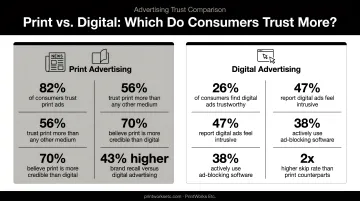
Print also performs well alongside digital, not just instead of it. USPS reports that 63% of marketers said coordinating direct mail and digital campaigns increases response rates — yet only 27% said they always actually do it. For businesses already running digital campaigns, adding print to the mix is one of the lowest-effort ways to lift overall response rates.
The Most Cost-Effective Print Marketing Materials
Cost-effectiveness isn't just about the lowest price per piece. It's the relationship between production cost, distribution reach, and how long the material stays in circulation. The formats below rank well on all three.
Business Cards
A well-designed business card remains one of the highest-ROI investments in any marketing budget. The cost per unit at volume is minimal, and every in-person interaction — a networking event, a client meeting, a chance encounter — becomes an opportunity to leave something tangible behind.
Design choices have real impact on both perception and price:
- Paper stock: Matte stocks convey a clean, modern feel; gloss finishes are brighter and more vivid. Both are cost-effective at standard weights.
- Standard sizing (3.5" × 2"): Keeps waste minimal and production costs down.
- Finishing options: Spot UV coating or soft-touch laminate add a premium feel without dramatically increasing cost per card.
For small businesses especially, business cards are the one print investment that should always be in stock. Running out at an event or meeting is a missed impression that can't be recovered.
Flyers and Postcards
Flyers and postcards are the workhorses of local marketing campaigns. They're fast to produce, easy to distribute, and adaptable to nearly any use case — seasonal promotions, event announcements, new service launches, grand openings.
The real cost advantage shows up with direct mail. USPS's Every Door Direct Mail (EDDM) program lets businesses saturate entire neighborhoods or zip codes with postcard-sized pieces at $0.247 per piece for EDDM Retail and as low as $0.242 per piece for EDDM BMEU — no targeted mailing list required. EDDM Retail doesn't even require a special mailing permit, which removes a barrier for smaller businesses.
For local restaurants, retailers, and service businesses, few formats offer this combination of scale and affordability. PrintWorks Etc handles end-to-end EDDM campaigns, managing everything from design and print through mail-prep, USPS presort, and postage optimization — so you're not chasing the logistics yourself.
Quick distribution options for flyers and postcards:
- In-person handouts at events or foot-traffic locations
- EDDM saturation mailings by zip code
- Targeted direct mail to purchased or house lists
- In-location placement (counters, waiting rooms, display racks)
Brochures
Brochures occupy a useful middle ground: more information than a postcard, more portable than a folder or lookbook. For service businesses, restaurants, healthcare providers, and trade show exhibitors, a well-designed brochure gives prospects something to take away and reference later — without requiring them to find your website first.
The key cost levers:
- Fold style: Tri-fold is the most economical and most familiar format. Gate folds and z-folds add visual interest but also add cost.
- Paper weight: Standard 100lb text stock hits a good balance of quality and price. Heavier stocks or specialty papers increase cost.
- Print run size: Printing in bulk for evergreen content (company overviews, service menus, general brand information) sharply reduces per-unit cost. Time-sensitive content should be kept to smaller runs.
For in-location use — hotel lobbies, waiting rooms, retail counters — brochures have proven staying power. A hospitality study found that 7 out of 10 tourists and visitors pick up brochures at their destination, and display stands influenced 69% of those pickups.
Promotional Products
Branded promotional items operate on a different cost model than paper-based print. Instead of a single impression, each item generates repeated exposure over months or years of daily use.
The numbers from ASI's research make the case clearly:
- 40% of consumers kept a promotional product for more than a decade
- Outerwear/fleece generates an average of 7,856 lifetime impressions per item
- T-shirts average 5,053 impressions; writing instruments 2,436
- 85% of consumers remembered the advertiser that gave them a promotional product
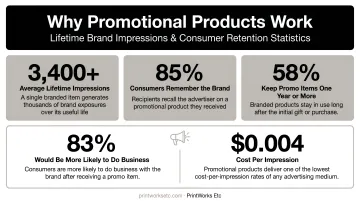
The best promotional products are ones people actually use. Drinkware, tote bags, quality pens, and apparel all perform well because recipients integrate them into daily life — which is exactly when your brand gets seen.
PrintWorks Etc manages the full promotional product process — from sourcing and sampling through decoration and kitting. Decoration methods include screen print, embroidery, laser engraving, and sublimation. Onboarding swag kit programs scale from 5–20 pieces per month for smaller teams up to 200+ for enterprise clients.
Posters and Signage
For businesses with a physical location or regular event presence, posters and banners are among the most cost-efficient formats available. A single well-placed banner or window display reaches every person who walks through the door or past the storefront, with no recurring cost per impression after the initial print.
POPAI's Shopper Engagement Study found that 76% of grocery purchase decisions are made in-store — a strong reminder that visibility at the point of consideration matters.
PrintWorks Etc produces the full range of event and retail signage, including:
- Retractable banners and vinyl banners
- Foam-core posters and floor graphics
- Tension-fabric booth walls and step-and-repeat backdrops
- A-frame sidewalk signs
- Full tradeshow booth kits
The team has executed signage at major venues across Southern California, including the LA, Anaheim, and San Diego Convention Centers.
How to Get the Most Value from Each Print Run
Digital vs. Offset: Choose the Right Method for the Volume
The choice between digital and offset printing has a direct impact on cost, and neither method wins in every situation.
- Digital printing has no setup plates, so there are no upfront setup fees. It's the right call for short runs, personalized pieces (variable data mailers), or seasonal content with a short shelf life.
- Offset printing requires plates to be made, which adds setup cost — but the per-unit price drops significantly at higher volumes. According to Ricoh and Keypoint Intelligence, the crossover point isn't a fixed number. It depends on job specs, paper size, and finishing requirements, with scenarios ranging from 4,000 to 12,000+ A4-equivalent sheets. Kao Collins puts a general crossover around 10,000 prints.
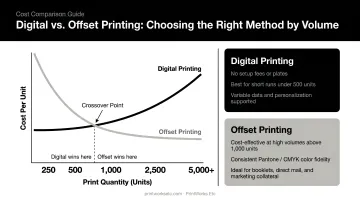
A print partner like PrintWorks Etc can manage runs from 25 copies (digital short-run) through 100,000+ (offset), matching your job to the most cost-effective production path based on volume, format, and finishing needs.
Design Choices That Directly Affect Cost
Smart design decisions reduce production costs without reducing visual impact:
- Standard paper sizes minimize trim waste and cutting charges
- Limiting bleeds reduces finishing costs on certain formats
- Two- or three-color palettes lower ink costs on select offset jobs
- Keeping special finishes to one per piece makes costs predictable
Print Evergreen Content in Bulk, Time-Sensitive Content in Small Runs
This single distinction prevents significant print budget waste:
- Print evergreen materials (company overviews, service menus, brand brochures, capability sheets) in larger quantities to capture volume pricing — the messaging typically holds for 12–24 months.
- Size time-sensitive materials (event flyers, promotional offers, seasonal campaigns) precisely to expected distribution — no more.
Working with a print partner who advises on quantities as part of the project process helps prevent the most common budget waste: over-ordering materials that never get distributed.
Matching Print Materials to Your Business Goals
Not every material belongs in every campaign. A practical framework:
| Goal | Best Materials |
|---|---|
| Brand awareness / first impressions | Business cards, brochures, presentation folders |
| Drive immediate action | Flyers, postcards, EDDM direct mail |
| Long-term brand visibility | Promotional products, posters, signage |
| Event presence | Signage + brochures + business cards + follow-up mailer |
The layered approach tends to outperform any single material. A trade show strategy, for example, works best when signage draws attention to the booth, brochures or flyers give visitors something to take away, business cards facilitate the exchange, and a follow-up postcard or mailer nurtures the relationship afterward.
One practical habit worth building: audit your print inventory against your active marketing goals at least once a year. Unused inventory is the most common way print budgets get quietly overspent — materials get ordered for campaigns that shift direction, or in quantities that far exceed what actually gets distributed.
For businesses in Los Angeles and Southern California, PrintWorks Etc handles this kind of strategic sourcing alongside full production execution — from a single business card run to a complete event signage package. As a WBEC-certified boutique agency, the team manages concept through delivery, routing each job through domestic or overseas production partners based on timeline, budget, and quality requirements. Contact PrintWorks Etc to discuss your next print project.
Frequently Asked Questions
What is the most economical way to print?
It depends on quantity. Digital printing is cheapest for small runs (under a few hundred pieces) because there are no setup fees. Offset printing becomes more cost-effective at higher volumes due to lower per-unit costs. Choosing standard paper sizes and limiting special finishes reduces overall spend at any volume.
What print marketing materials have the best ROI?
Business cards and postcards are consistently cited for high ROI due to low production cost and broad reach. Direct mail response rates have been documented at 9% for house lists and 5% for prospect lists — far above email and paid search, and promotional products extend that ROI further through repeated impressions over months or years.
How much should a small business budget for print marketing?
The SBA cites average marketing spend of roughly 7.9% of revenues for small businesses, with advertising closer to 1.08%. Starting with business cards and one targeted campaign material is a practical first step.
Is print marketing still effective for small businesses?
Yes. Print is tangible and trusted — consumers consistently rate print ads as more credible than digital formats. For local businesses especially, direct mail and in-location print (menus, signage, brochures) continue to drive measurable engagement where digital ads get ignored.
What's the difference between digital and offset printing?
Digital printing has no setup plates, making it ideal for short runs and personalized pieces; offset requires upfront plate costs but delivers a much lower per-unit price at volume. Use digital for runs under a few hundred pieces and offset for large bulk orders of evergreen materials.
How do I avoid wasting money on print marketing materials?
Plan print quantities based on a realistic distribution calendar, avoid printing time-sensitive information on evergreen pieces, and audit existing inventory before reordering. An experienced print partner who advises on quantities and production timing can prevent costly over-orders before they happen.