Professionally designed postcards offer a surprisingly powerful answer. Unlike a fleeting social media ad, a postcard is a physical object that gets noticed, held, and read. It can sit on a counter or a desk for days, keeping your business top-of-mind. This article will break down why postcards are a marketing powerhouse, the essential elements of a design that converts, and why partnering with a professional can make all the difference for your return on investment.
TL;DR: Key Takeaways on Postcard Marketing
- Tangible & Effective: Direct mail has a longer lifespan in a home or office than digital ads, leading to higher engagement and response rates.
- Design is Crucial: A great postcard needs a compelling headline, a striking visual, a clear offer, and a strong call-to-action to work.
- Professionalism Pays: DIY design often leads to costly technical mistakes in printing and mailing that hurt your ROI.
- A Managed Process Saves Time: Working with a professional team streamlines everything from initial strategy and design to printing and mailing logistics.
Why Postcards Are Still a Marketing Powerhouse for Small Businesses
While it might seem old-school, direct mail marketing—especially postcards—delivers results that digital channels often struggle to match. The key is its physical nature. An email can be deleted in a second, but a postcard has to be handled.
A report from the SBA shows the average direct mail piece stays in a home for 17 days, compared to just a few seconds for an email. That gives your message significantly more time to be seen and considered.
This high engagement translates into impressive returns. A recent ANA report found that direct mail generates an average ROI of 92%, making it a smart investment for growth-focused businesses.
For local businesses, the benefits are even more pronounced. Postcards offer powerful hyper-local targeting capabilities. You can focus your campaign on:
- Targeting specific neighborhoods or postal routes to attract nearby customers.
- Filtering by demographic data like income level or household size.
- Engaging your existing customer list to encourage repeat business and loyalty.
This precision makes postcards perfect for restaurants, local service providers, real estate agents, and retail shops that need to reach a specific geographic area without wasting their marketing budget.
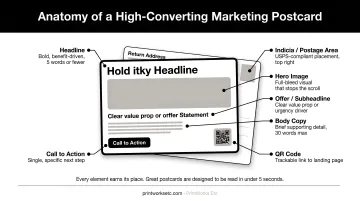
The Anatomy of a High-Converting Postcard: Key Design Elements
A successful postcard isn’t just a piece of paper; it’s a carefully crafted marketing tool. You have about three seconds to grab someone's attention as they sort their mail. Here’s how to make every second count.
A Compelling Headline and Striking Visuals
The front of your postcard is your first impression. It needs a bold, benefit-driven headline that speaks directly to a customer's problem or desire. Pair it with a single, high-resolution image that showcases your product or service in an appealing way.
Think action and solution. Instead of a generic headline like "Plumbing Services," try something that offers an immediate solution and a clear value proposition: "Clogged Drain? We'll Fix It Today for Just $99!"
Clear, Concise, and Scannable Copy
Once you have their attention, your message needs to be easy to digest. No one is going to read a novel on a postcard. Use simple language, short sentences, and bullet points to communicate your value.
Always focus on the "What's In It For Me?" (WIIFM) principle. Every word should highlight a benefit for the customer.
- Saves you time and hassle
- Weekend appointments available
- 100% satisfaction guarantee
An Irresistible Offer and a Strong Call-to-Action (CTA)
A great postcard inspires action. The best way to do this is with a compelling, time-sensitive offer. This creates a sense of urgency that encourages people to respond now rather than later.
Good offers include:
- A percentage discount (e.g., "20% Off Your First Service")
- A free item or consultation ("Free Estimate" or "Buy One, Get One Free")
- A special introductory price for new customers
Your Call-to-Action (CTA) must be impossible to miss. Make it direct, clear, and visually prominent. Use action-oriented language like "Call Us Today," "Scan to Book Online," or "Bring This Card In for Your Discount."
Essential Business and Branding Information
Finally, make it easy for customers to connect with you. Every postcard must include these non-negotiable elements:
- Company logo and name
- Phone number
- Website
- Physical address (if you have a storefront)
Ensure your branding elements—colors, fonts, and overall style—are consistent with your website and other marketing materials. This consistency is essential for building brand recognition and trust, a core principle in every project we manage at PrintWorks Etc.
DIY vs. Professional Design: Why Expertise Matters for Your ROI
With so many online templates available, it can be tempting to design your postcard yourself to save money. But this approach often comes with hidden costs and pitfalls that can sabotage your campaign before it even starts.
The DIY Approach: When It Might Work (and Its Pitfalls)
For a very simple announcement with an extremely tight budget, a template might seem like a good starting point. However, DIY design is fraught with common mistakes that a professional would avoid.
Common DIY Pitfalls:
- Generic templates that make your postcard blend in with your competitors.
- Low-resolution images that look blurry and unprofessional in print (always use 300 PPI).
- Incorrect file setup, such as using the wrong color mode (CMYK, not RGB) or forgetting a "bleed."
- USPS regulation errors that can get your mail piece rejected or delayed.
These technical errors lead to wasted print runs, unexpected fees, and a poor reflection on your brand.
The Professional Advantage: Strategic Design That Converts
A professional graphic designer does more than just make things look good. They create a strategic marketing asset designed to get a response.
They understand visual hierarchy, guiding the reader's eye from the headline to the offer and the call-to-action. Designers also use color psychology and typography to evoke the right emotion and ensure your message is clear and compelling.
Most importantly, a professional creates a custom design that reflects your unique business. This sets you apart and builds a brand identity customers will remember.
The Value of a High-Touch Partnership
Working with a boutique firm like PrintWorks Etc offers a partnership, not just a transaction. Instead of uploading a file to a faceless website and hoping for the best, you get a dedicated team of experts managing your project from concept to delivery.
Our team, including specialists like Graphic Designer Julie Sato and Sales & Production Manager Amy Carichner, absorbs the complexity so you can focus on running your business.
We handle the technical details, source the right materials, and manage the entire production process. This high-touch service ensures quality control at every step, saving you valuable time and the stress of navigating the print and mail process alone.
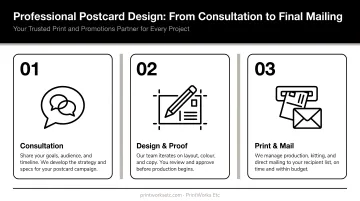
The Professional Postcard Design Process: From Concept to Mailbox
Working with a professional team simplifies creating a postcard campaign. Here’s a look at our typical workflow, designed to be seamless and collaborative.
- Initial Consultation & Strategy: We start by taking the time to understand your campaign goals, target audience, budget, and key message. We'll help you craft a compelling offer that will resonate with your customers.
- Creative Design & Proofing: Our design team gets to work, creating initial concepts based on the strategy we developed together. You'll receive a digital proof to review, and we'll work with you on any revisions until the design is perfect.
- Finalization, Printing, & Mailing: Once you approve the final design, we manage all production and mailing logistics. We oversee everything from paper selection and quality control to acquiring a mailing list and ensuring your postcards are delivered on time.
Understanding the Costs: A Breakdown of Postcard Marketing Investment
The total investment for a postcard campaign is a combination of three key components: design, printing, and postage.
Design Fees
Think of professional design as a one-time investment in a reusable marketing asset. Fees can be structured as an hourly rate or a flat project fee, depending on the complexity. While rates vary, the median hourly pay for a graphic designer can be around $29.47, reflecting the expertise required to create a strategic, print-ready file. This upfront investment helps you avoid the costly mistakes of a DIY approach and ensures your files are correctly prepared for the press.
Printing Costs
The price of printing is influenced by several factors:
- Order volume: The cost per postcard drops significantly as your order quantity increases.
- Postcard dimensions: Standard sizes like 4"x6" are more economical, while larger 6"x9" cards make a bigger impact at a higher cost.
- Paper quality: Thicker, higher-quality paper stock feels more premium and adds durability.
- Specialty finishes: Add-ons like a glossy UV coating or a soft-touch matte finish can make your card stand out.
Postage and Mailing Service Fees
Postage is a major part of the budget. Rates depend on the size of the postcard and the class of mail. For small businesses targeting a local area, Every Door Direct Mail (EDDM) is a cost-effective option from the USPS. EDDM allows you to target specific postal routes without needing to purchase a mailing list, with rates that can be as low as $0.247 per piece.
Frequently Asked Questions
How much do marketing postcards cost?
Costs vary widely based on design complexity, print quantity, size, and postage. Your total investment will be split between three areas: a one-time design fee, per-piece printing costs, and per-piece postage fees.
What is the best size for a marketing postcard?
Common sizes like 4"x6" are the most cost-effective for meeting USPS First-Class postcard rates. Larger sizes like 6"x9" or 6"x11" stand out more in the mailbox but typically cost more to print and mail as letters or flats.
What information must be included on a marketing postcard?
The essentials are a compelling headline, a clear offer, a strong call-to-action, your business name and logo, and contact information (website and phone number).
Is postcard marketing still effective for small businesses?
Absolutely. Postcard marketing remains highly effective due to its high engagement rates and long lifespan in the home. It's an excellent tool for precisely targeting local customers and connecting with your community.
What is the difference between direct mail and EDDM?
Standard direct mail involves sending mail to a specific list of names and addresses. EDDM (Every Door Direct Mail) is a USPS program that delivers your mailer to every address on a chosen postal route, which is ideal for broad local saturation without a list.