This guide breaks down every cost component in a 2026 direct mail campaign: postage, printing, list data, design, lettershop, and the hidden line items most quotes leave out. Whether you're planning a neighborhood EDDM drop or a targeted B2B letter campaign, you'll have the numbers to plan accurately.
Key Takeaways
- All-in cost runs $0.30–$3.00 per piece; standard addressed postcard campaigns land at $0.55–$0.90
- Postage is the largest cost driver, typically 35–60% of per-piece total
- EDDM offers the lowest all-in cost for local saturation; First-Class targeted campaigns cost the most
- Every campaign price builds from four components: postage, printing, list/data, and lettershop/design
- Budget $2,500–$4,500 total for a typical 5,000-piece postcard campaign
How Much Does a Direct Mail Campaign Cost in 2026?
There's no sticker price for direct mail. The per-piece cost shifts based on format, volume, postage class, and whether you're managing vendors yourself or working with a full-service partner.
The mistake most marketers make is comparing vendors on a single line item — usually print price. A printer quoting $0.08 per piece looks cheap until you add postage, lettershop, and list costs and realize the true all-in total is $0.75.
The right comparison is always total cost per piece delivered.
Typical Cost Ranges by Campaign Scale
The ranges below show what that total typically looks like across common campaign types.
| Campaign Type | Volume | All-In Cost Per Piece | Total Budget Range |
|---|---|---|---|
| EDDM / saturation | 1,000–5,000 pieces | $0.30–$0.55 | ~$300–$2,750 |
| Addressed Marketing Mail | 5,000–25,000 pieces | $0.55–$0.90 | ~$2,500–$22,500 |
| First-Class or large format | Any volume | $0.85–$3.00+ | Varies widely |
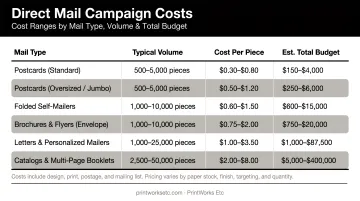
These figures are based on public 2026 vendor benchmarks and are not drawn from USPS or ANA published standards.
Typically included in these ranges:
- Printing
- Postage
- Basic list or EDDM route selection
- Lettershop prep
Typically excluded:
- Design and copywriting
- Address list cleaning (NCOA)
- Variable data printing
- Tracking setup
A 5,000-piece postcard campaign often runs $2,500–$4,500 total. A 25,000-piece letter campaign with a targeted prospect list can reach $15,000–$30,000+. Use those totals as gut-check anchors when reviewing vendor quotes.
The Four Core Cost Components of a Direct Mail Campaign
Every per-piece price is built by stacking four components. Understanding each one tells you where your money goes — and where there's room to negotiate.
Postage
Postage is the heaviest line item in almost every campaign, typically 35–60% of the all-in per-piece cost.
Current USPS rates effective April 26, 2026 (Notice 123):
| Mail Class | Rate Per Piece |
|---|---|
| EDDM Retail flats (up to 3.3 oz) | $0.247 |
| Marketing Mail letter, automation 5-Digit | $0.372 |
| Marketing Mail letter, automation Mixed AADC | $0.433 |
| First-Class letter, automation 5-Digit | $0.593 |
| First-Class letter, automation Mixed AADC | $0.672 |
| First-Class retail stamp (1 oz) | $0.78 |
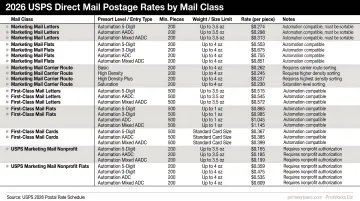
USPS filed proposed Market Dominant price changes on April 9, 2026 (Docket No. R2026-1), scheduled for July 12, 2026, with average increases of 4.803% for First-Class Mail and Marketing Mail. Budget accordingly for campaigns mailing after that date.
Printing
Format is the main driver of print cost. At 1,000 pieces, benchmarks from commercial printer price pages run:
- 4x6 postcard: ~$0.08–$0.10 per piece (print only)
- 6x9 postcard: ~$0.17–$0.21 per piece (print only)
- #10 letter + envelope: ~$0.20–$0.45 per piece (print only; all-in mailed cost is higher)
Per-piece print cost drops sharply between 1,000 and 5,000 pieces as press setup gets amortized across the run, then flattens at higher volumes.
If you're near a volume threshold, running a few hundred extra pieces is often cheaper than stopping short — the per-piece savings rarely justify the gap.
Mailing List and Data
List costs vary significantly by targeting depth:
- Consumer prospect lists: roughly $50–$150 per 1,000 records ($0.05–$0.15/record) — vendor market range
- B2B lists with title/revenue filters: roughly $100–$350 per 1,000 records ($0.10–$0.35/record) — vendor market range
- House lists: free on the list itself, but should include NCOA processing to catch movers before print
For house lists, NCOA processing is worth doing before you print. USPS NCOALink covers roughly 160 million permanent change-of-address records, and catching bad addresses upfront prevents wasted postage. TrueNCOA's published pricing starts at $20 for up to 2 million records — minimal cost relative to what it saves.
Design, Copywriting, and Lettershop
- Design runs $0 with in-house or provided templates; $150–$300/hour for a professional designer or agency
- Copywriting ranges from $200–$2,000 depending on complexity and writer experience
- Lettershop labor (addressing, sorting, traying, postal induction) typically adds $0.03–$0.15 per piece
Lettershop cost increases with complexity — inserting a letter into an envelope with a BRE costs more than running a postcard through an addressing system. Variable data jobs (different copy or images by segment) add another layer of setup cost.
Key Factors That Affect Direct Mail Campaign Costs
Four campaign-level decisions move total cost more than any single vendor negotiation. Getting these right upfront can reduce total spend by 20–35% without touching response rates.
Volume and Presort Thresholds
USPS Business Mail 101 sets clear minimums:
- 200 pieces or 50 lbs → unlocks USPS Marketing Mail Presort
- 500 pieces → qualifies for First-Class Presort automation rates
The postage savings at these thresholds are real. Marketing Mail automation 5-Digit at $0.372 versus a $0.78 retail stamp saves $0.408 per piece — about 52% on postage alone. Even adding a handful of names to hit the 200-piece floor pays for itself immediately.
Format Choice
Format is the second-biggest cost lever after postage:
- 4x6 postcard: ~$0.40–$0.65 all-in
- 6x9 postcard: ~$0.55–$0.90 all-in
- 9x12 flat or self-mailer: ~$1.20–$2.50+ all-in
Smaller formats aren't always the right call. A larger format with a higher response rate can deliver a lower cost per response. Match format complexity to message complexity — a simple coupon or reminder doesn't need a dimensional mailer.
Postage Class and Mailing Method
| Method | Postage Cost | Targeting | Speed |
|---|---|---|---|
| EDDM | $0.247/piece | Carrier route only | Standard |
| Marketing Mail Presort | $0.372–$0.433/piece | Named addresses | 3–10 business days |
| First-Class Presort | $0.593–$0.672/piece | Named addresses | 1–3 business days |
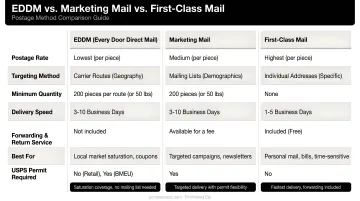
Postage class choice swings total campaign cost by 30–45%. First-Class costs more but forwards on bad addresses and delivers faster — worth it for high-value prospect campaigns. EDDM is the cheapest path but limits targeting to entire carrier routes.
List Quality and Targeting Precision
Every undeliverable piece wastes both print cost and postage — no exceptions. USPS tracks UAA (Undeliverable-as-Addressed) volume and provides NCOALink to reduce it. Address hygiene steps to prioritize before print:
- Run NCOALink to catch address changes in the past 48 months
- Deduplicate to eliminate duplicate records in the same household
- Suppress known bad addresses from previous campaign returns
- Segment tightly — a specialty list costs more per record but cuts waste and lifts response rates
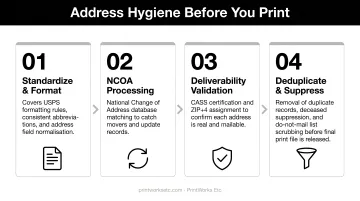
Skipping these steps on a 5,000-piece campaign at $0.65 all-in can mean $300–$500 in wasted spend before a single piece is read.
Hidden Costs Most Direct Mail Budgets Miss
Most vendor quotes show print price and postage. Several line items don't show up until the invoice does.
Hidden cost checklist:
NCOA and address hygiene — Often excluded from printing quotes. TrueNCOA's published rate starts at $20 for up to 2 million records. Worth it on any list that hasn't been cleaned recently.
Variable data printing (VDP) — Adds setup and per-piece cost beyond standard printing. Keypoint Intelligence research found roughly two-thirds of recipients pay more attention to personalized mail, but VDP pricing varies by platform and volume — always get a specific quote.
Tracking infrastructure — Tracked QR codes and pURLs (personalized URLs) both carry platform costs that aren't always included in base pricing. Some providers bundle them; others charge per piece. Confirm in writing before assuming they're covered.
Postage pre-funding — USPS requires postage paid before mail ships. On a 25,000-piece campaign at $0.433/piece, that's over $10,000 cash out the door before a single piece delivers. Factor that into cash flow planning.
The simplest way to avoid surprises: request a fully itemized, all-in quote that breaks out print, postage, list/NCOA, lettershop, design, and tracking as separate line items.
How to Reduce Direct Mail Costs Without Sacrificing Results
The biggest savings come from postage optimization and data hygiene — not from cutting paper stock or skimping on design. Cutting quality typically kills response rates and destroys ROI faster than it saves money.
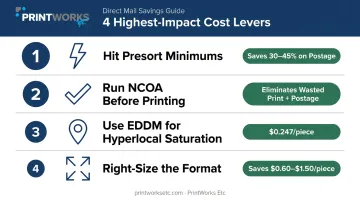
Four highest-impact cost levers, in order:
Hit presort minimums — Even adding a few names to reach the 200-piece Marketing Mail or 500-piece First-Class floor saves 30–45% on postage per piece. This is the single fastest way to reduce per-piece cost.
Run NCOA before printing — Eliminating undeliverable addresses saves both postage and print cost on every bad record. On a 10,000-piece list with even modest address decay, this step pays for itself.
Use EDDM for hyperlocal saturation — Restaurants, home services, dental practices, roofing companies, and other neighborhood-focused businesses often don't need household-level targeting. EDDM at $0.247/piece is the cheapest path to scale when carrier-route coverage is enough.
Right-size the format — A simple seasonal offer or appointment reminder doesn't require a 9x12 flat. Match format complexity to message complexity and save $0.60–$1.50 per piece in the process.
Working with a full-service partner like PrintWorks Etc — who handles design, list hygiene, USPS presort, and mail-house coordination under one roof — removes the overhead of managing those vendors separately. When one team owns the whole project, line-item surprises get caught before they hit your invoice.
Frequently Asked Questions
How much does it cost to do a direct mail campaign?
Total campaign cost ranges from roughly $300 to $37,000+ depending on volume and format. On a per-piece basis, expect $0.30–$3.00 all-in. A standard 5,000-piece addressed postcard campaign typically runs $2,500–$4,500 total including printing, postage, list, and basic lettershop.
What is the success rate of direct mail campaigns?
According to ANA/DMA research, direct mail house-list response rates average around 5% and prospect-list rates around 2–3%, compared to roughly 0.6% for email. Direct mail costs more per touch but delivers significantly higher response rates, which often makes cost-per-lead competitive.
What is the cheapest type of direct mail to send?
EDDM (Every Door Direct Mail) is the most affordable option at roughly $0.30–$0.55 per piece all-in. It eliminates list rental costs and uses the lowest USPS postage tier at $0.247/piece, though targeting is limited to carrier routes rather than specific named households.
What factors most affect direct mail campaign cost?
The four biggest levers are: volume (higher volume = lower per-piece cost), format (4x6 postcard vs. 9x12 flat), postage class (EDDM vs. Marketing Mail vs. First-Class), and list quality (EDDM vs. rented consumer list vs. targeted B2B list).
How much does direct mail postage cost in 2026?
Per USPS Notice 123 (effective April 26, 2026): EDDM flats at $0.247, Marketing Mail letter automation at $0.372–$0.433, and First-Class letter automation at $0.593–$0.672. USPS has filed proposed increases averaging 4.803% effective July 12, 2026. Budget for that increase on any campaign mailing mid-year or later.
Is direct mail worth the cost compared to digital advertising?
Digital is cheaper per impression, but direct mail delivers materially higher response rates. The right comparison isn't cost per touch — it's cost per response or cost per acquisition. For campaigns targeting high-value prospects or local households, direct mail's response rate advantage frequently closes the cost gap with paid digital channels.