Research from Dotcom Distribution's 2022 study of 1,150 U.S. online shoppers found that premium packaging makes 51% of consumers more likely to view a brand as upscale and 34% more likely to shop with that brand again. Generic brown boxes leave that opportunity on the table.
This guide covers everything you need to make informed custom packaging decisions: which box formats exist and when to use them, how design elements work together, what materials and printing methods are available, and how to navigate the ordering process from brief to delivery.
Key Takeaways
- Premium packaging directly affects repeat purchases, brand perception, and social sharing — not just aesthetics.
- Box style should match your product's weight, shipping method, and retail context; no single format works for every product.
- Print finish, color accuracy, and dieline structure all affect the final result — getting one wrong undermines the rest.
- When design and production are managed together, as PrintWorks Etc does, handoff errors drop and timelines tighten.
Why Custom Product Box Packaging Matters for Your Brand
Packaging communicates quality before the product is even seen — and it's one of the few brand touchpoints a customer can physically hold. That makes it more powerful than most marketing channels, and the data backs it up.
A Dotcom Distribution study found that 30% of consumers are more likely to share photos or videos when packaging feels gift-like. For e-commerce brands, where unboxing is often the only physical brand interaction, that's meaningful reach without any media spend.
Beyond Aesthetics: The Functional Case for Custom Boxes
Generic stock boxes create real operational costs beyond brand impression:
- Oversized packaging increases dimensional weight charges, adding unnecessary shipping costs on every order
- Void fill adds material cost, weight, and an off-putting unboxing experience
- Off-brand presentation disconnects the product from the brand — the opposite of what packaging should accomplish
Right-sized custom corrugated can make a measurable difference. Crutchfield's D2C operation reported $300,000 in first-year void-fill savings after implementing a right-sized case system that cut overall box dimensions in half for some product lines.
Packaging Goals Vary by Business Type
- E-commerce brands prioritize unboxing experience and shipping durability
- Brick-and-mortar retailers prioritize shelf visibility and structural integrity
- Corporate gift programs prioritize premium presentation and perceived value
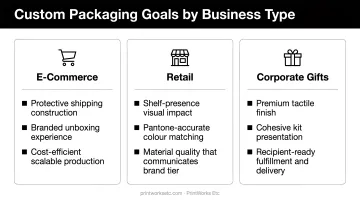
The right packaging strategy starts with knowing which goal is yours.
Types of Custom Product Boxes: Finding the Right Fit
"Custom product box" covers a wide range of structural formats. The right choice depends on product weight, fragility, retail context, and the impression you want to create.
Folding Cartons
Folding cartons (paperboard boxes) are the standard format for retail-ready consumer goods — cosmetics, candles, food products, and subscription boxes all commonly use them. They're lightweight, flat-pack for storage efficiency, and offer printable surface area across all six panels.
Best for: products that don't need heavy structural support and will be displayed on shelves or shipped inside a shipper box.
Rigid Boxes
Rigid (set-up) boxes are non-collapsible, thick-walled, and built for premium products: electronics, watches, high-end gift sets. The structure and weight communicate value before the customer ever opens the lid. They cost more per unit and can't be flat-packed for storage like folding cartons.
Best for: luxury products where the packaging is as much a part of the experience as the product inside.
Corrugated Shipping Boxes
Corrugated board (linerboard with a fluted medium) comes in single-wall, double-wall, and triple-wall configurations. It's the go-to for e-commerce and direct-to-consumer shipping because of structural strength and product protection. Corrugated boxes can still be fully branded: printed exteriors, custom inserts, and interior printing are all achievable.
Best for: products shipped direct to consumers where protection is the primary requirement.
Mailer Boxes and Subscription Boxes
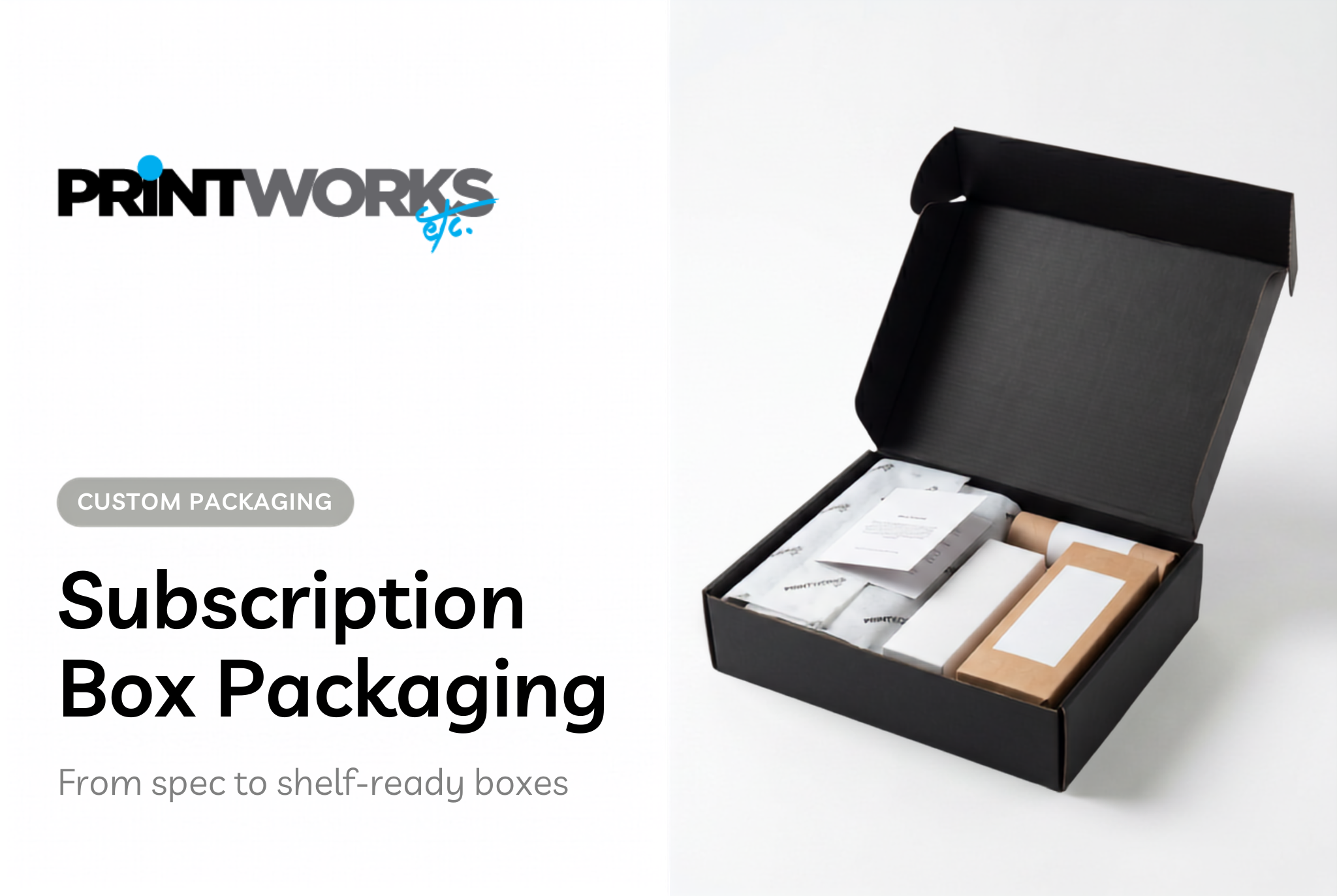
Mailer boxes bridge the gap between corrugated shipping boxes and retail cartons. They're sturdy enough to ship without an outer shipper, fully printable inside and out, and self-locking — no tape required. Customers get a clean, polished opening experience without scissors or torn tape.
PrintWorks Etc has produced mailer packaging for clients including Disney Movie Club, managing the full production cycle from concept through overseas vendor execution and delivery.
Best for: DTC brands and subscription box programs where the unboxing experience carries brand weight.
Display and Specialty Boxes
Specialty formats serve specific retail and gifting contexts:
- Drawer boxes (ribbon-pull) for premium gifting
- Window boxes with die-cut openings for product visibility on shelf
- Pillow boxes for lightweight retail items
- Shelf-ready display boxes for retail floor placement
When a standard rectangular format doesn't serve the product's presentation needs, these formats are worth considering.
Key Design Elements of an Effective Custom Box
Great custom box design goes well beyond visual appeal. A design that looks perfect on screen but ignores print bleed, fold lines, or color limitations will fail in production — and structure, brand communication, and feasibility all factor into whether it succeeds.
Structure and Dieline
Every custom box starts with a dieline — a flat technical template showing where the box is cut, folded, and perforated to create the final structure. Designers must work within the dieline, not treat box faces as flat canvases.
Common mistakes:
- Artwork crossing fold lines incorrectly (text or logos get split at edges)
- Ignoring safe zones (important elements end up trimmed or hidden at folds)
- Placing barcodes without accounting for GS1 quiet zone requirements
GS1 US barcode placement guidelines specify that retail barcodes belong in the lower right-hand back section, require quiet zones, and should not be truncated or resized without recreating the symbol.
Color, Logo Placement, and Brand Consistency
Screen colors and printed output differ — sometimes significantly. The two systems to know:
- CMYK (process color): Four-color ink screens; standard for most packaging print
- Pantone (PMS/spot color): Premixed ink applied directly; used when brand color accuracy is critical
When exact brand color reproduction matters, PMS is the more reliable choice. Always work from a brand style guide when determining which face carries the primary logo, how side panels support the design, and how brand elements scale across all six surfaces.
Typography and Copy Hierarchy
Box real estate is limited. Every panel needs to serve a purpose — product name, tagline, ingredient or legal copy, and barcodes all have to coexist without visual clutter.
Typography hierarchy (size, weight, placement) guides the reader's eye across panels. For regulated copy, FDA food-label guidance requires required type to be at least 1/16 inch in height for most applications. For non-regulated copy, the practical minimum for readable print is typically 6–7pt, though confirming minimums with your printer's specifications is always the right move.
Finish and Special Treatments
Finishing options that improve how a box looks and feels in hand:
| Finish | Best Use Case |
|---|---|
| Matte lamination | Clean, modern aesthetic; reduces fingerprints |
| Gloss lamination | Vivid color saturation; high visual impact |
| Soft-touch coating | Tactile premium feel; pairs well with luxury products |
| Spot UV | Gloss highlights on matte backgrounds; draws attention to logos or graphics |
| Foil stamping | Metallic or holographic effects; high-end gifting and collectibles |
| Embossing/debossing | Raised or recessed tactile design elements |
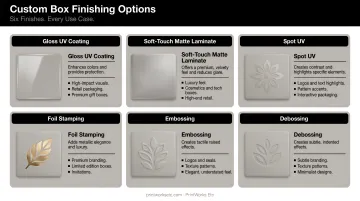
PrintWorks Etc has applied foil stamping as a finishing technique for collectible programs, including work for Disney Movie Club where foil-stamped logos elevated the perceived value of the final product.
Cost-sensitive projects may reasonably stick to standard lamination. Premium products are a different story: tactile finishes register with customers in ways that flat print alone doesn't.
Working With a Designer on Box Artwork
Custom box design is more technically complex than standard flat print work. A designer who understands dielines, print-ready files, and how materials behave catches problems before they become expensive reprints.
That alignment matters from day one. Some packaging partners, like PrintWorks Etc, offer in-house graphic design alongside sales and production support — so creative and production decisions stay coordinated rather than being managed across two separate vendors.
Materials and Printing Options for Custom Packaging
Material and printing choices are interconnected. The substrate affects which printing methods work, which finishes are achievable, and how the box feels in hand.
Common Box Materials
| Material | Characteristics | Best For |
|---|---|---|
| SBS paperboard | Bright white, clay-coated, vivid print quality | Cosmetics, food, retail cartons |
| Kraft paperboard | Natural brown, tear-resistant, eco aesthetic | Hardware, beverage, organic brands |
| Coated recycled paperboard | Made from post-consumer fibers | Dry food, cereal, eco-conscious brands |
| Chipboard/greyboard | Thick, rigid, non-folding | Rigid/set-up box body stock |
| Corrugated board | Linerboard + fluted medium; structural strength | Shipping, DTC, e-commerce |
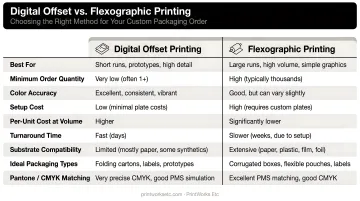
Printing Methods: Digital, Offset, and Flexographic
Digital printing
- Best for short runs, on-demand production, and prototypes
- Can deliver some orders in days rather than weeks
- Lower setup cost; no plates required
- Variable data capability — useful for different SKUs, personalization, or regional versioning
Offset/lithographic printing
- Higher color accuracy and Pantone matching
- Lower per-unit cost at larger volumes
- Best for fine detail and consistent color across long runs
Flexographic printing
- Common for corrugated boxes and high-volume runs
- Works well where fine detail reproduction isn't the primary requirement
The right method depends on your order size, color accuracy requirements, and timeline.
Eco-Friendly and Sustainable Packaging Options
According to the same Dotcom Distribution research, 66% of e-commerce consumers cite eco-friendly packaging as the factor most likely to make them shop with a brand. FSC research adds that 62% of consumers actively try to buy products packaged with renewable materials.
Sustainable options to consider:
- FSC-certified materials (chain-of-custody verified sustainable sourcing)
- Coated recycled paperboard (post-consumer fiber content)
- Soy-based inks (plant-derived alternative to petroleum inks)
- Reduced material weight through right-sizing
Sustainable choices don't always mean higher cost. Lighter materials often reduce both material spend and shipping weight — a double benefit.
Inserts, Tissue Paper, and Interior Elements
The inside of the box is part of the design experience. Interior elements serve both protective and brand functions:
- Die-cut foam or cardboard inserts hold products in position and prevent movement during shipping
- Custom tissue paper adds a reveal layer to the unboxing moment
- Printed interior panels extend brand messaging inside the box
- Branded tape or stickers reinforce the brand at seal points
Planning interior elements alongside the outer box — rather than after it — keeps dimensions, weight, and brand experience aligned from the start.
How to Order Custom Product Boxes: From Concept to Delivery
Knowing the process ahead of time prevents the most common (and costly) ordering mistakes.
The Typical Ordering Sequence
- Brief and specs — product dimensions, quantity, box style, shipping method, and brand assets
- Quote and material/print recommendations — your partner evaluates options and provides pricing
- Dieline creation and design approval — artwork is placed within the structural template
- Sample or proof sign-off — physical structural sample confirms fit; printed proof confirms color and finish
- Production and delivery — manufacturing begins after approved sign-off
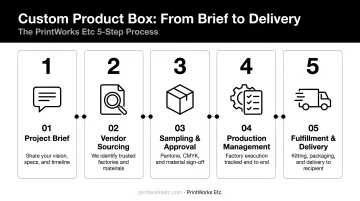
Never skip Step 4. A structural sample that reveals a fit problem before production costs far less than a reprinted run afterward.
Variables That Affect Pricing and Lead Time
- Order quantity — higher volumes reduce per-unit cost; MOQs vary by printing method
- Box complexity — number of colors, structural features, and finishing treatments all affect cost
- Printing method — digital runs typically cost more per unit but less to set up; offset reverses that equation at volume
- Production origin — domestic production is faster; overseas production typically offers lower per-unit cost but requires longer lead time for shipping
For brands balancing quality and budget, working with a partner that has both domestic and overseas factory relationships — as PrintWorks Etc does — provides flexibility without being locked into one option.
Practical Advice for First-Time Buyers
- Measure with inserts and padding included — the box needs to fit the full contents, not just the product itself
- Request a sample before committing to volume — it's the fastest way to confirm fit, color, and structure
- Submit high-resolution PDFs with embedded fonts, correct color profiles (CMYK or Pantone), and appropriate bleed
- Check file specs with your printer before submitting — requirements vary, and mismatches cause delays
PrintWorks Etc reviews files before production starts and catches spec issues early — so the first run is the right run.
Frequently Asked Questions
What is the minimum order quantity for custom product boxes?
MOQs vary by box type and printing method. Digital printing typically supports shorter runs, while offset and corrugated production generally requires higher minimums. Confirm MOQ requirements with your packaging partner early in the process — it affects both budgeting and your timeline.
How long does it take to produce custom product packaging?
Timelines vary by complexity and production origin. Design and proofing typically takes 1–2 weeks; domestic production runs longer from there; overseas production adds shipping time on top of manufacturing. Ask your supplier about rush production upfront, and factor lead time into your project plan before finalizing launch dates.
What file formats are needed for custom box artwork?
Most printers require high-resolution PDFs with embedded fonts, correct color mode (CMYK or Pantone), and bleed included. Files should be placed within the printer's provided dieline. Always request the printer's art specifications document before finalizing files.
Can I get a sample or prototype before placing a full order?
Most packaging suppliers offer structural samples (blank dieline mockups) and printed proofs to confirm color and finish. Requesting both before committing to a full production run is strongly recommended — catching fit or color issues at the sample stage costs far less than reprinting an entire run.
What's the difference between digital and offset printing for packaging?
Digital printing suits small quantities, fast turnarounds, and variable data. Offset printing delivers higher color fidelity, Pantone accuracy, and lower per-unit cost at larger volumes. The right choice depends on order size, color requirements, and budget.
How do I choose the right box style for my product?
Consider product dimensions and fragility, whether it's shipping direct or going on shelf, your budget, and the brand impression you want to create. Folding cartons suit retail shelf display; mailer boxes suit DTC shipping; rigid boxes suit premium gifting. PrintWorks Etc can help you match the right format to your product, timeline, and budget from the start.