That disconnect is why healthcare organizations are returning to direct mail — not as a nostalgic throwback, but as a deliberate response to digital saturation. According to USPS health-sector data, healthcare direct mail response rates most commonly fall between 11% and 15%, with 16% of health businesses reporting rates above 25%. That's a channel worth understanding.
This guide is for healthcare providers, clinics, health systems, and marketing teams. You'll learn how to plan, execute, and measure a compliant, high-performing healthcare direct mail campaign — from list strategy to HIPAA safeguards to omnichannel integration.
Key Takeaways
- Healthcare direct mail response rates typically run 11%–15%, far above most digital benchmarks
- Physical mail from a trusted provider carries credibility that digital channels can't replicate
- HIPAA compliance is non-negotiable and governs every stage: data use, printing, and delivery
- Embedding QR codes, PURLs, or unique phone numbers makes direct mail fully measurable
- Coordinating mail with email or SMS consistently outperforms either channel used alone
Why Healthcare Direct Mail Still Works in a Digital World
Patients receive dozens of healthcare-adjacent emails and digital ads every week. Most never get opened. The average inbox has become a filter, not a channel — and healthcare messages that land there often get dismissed alongside promotional noise.
Physical mail bypasses that entirely. It arrives in the home, gets handled, and commands a moment of attention that a promotional email never gets.
The Performance Gap Is Real
USPS health-sector metrics show healthcare direct mail response rates of 11%–15% as the typical range, with a meaningful percentage of health businesses exceeding 25%. That translates to patients calling, booking appointments, and responding to outreach — not just passively viewing a message.
For context, average email open rates in healthcare hover well below that threshold, and click-to-action rates are lower still. Direct mail doesn't compete with email on cost-per-piece. It competes on whether the communication actually prompts a response.
Younger Patients Aren't Immune
A common assumption is that direct mail works only on older demographics. The data doesn't support it. Lob's 2025 consumer research of 2,000 U.S. adults found that Gen Z and Millennials — the same generations drowning in digital notifications — engage with physical mail at surprisingly high rates:
- 85% of Gen Z and Millennials engage with direct mail
- 67% take action after receiving it
- 49% of consumers view brands that send physical mail as more credible
- 44% see it as more authentic than digital communications
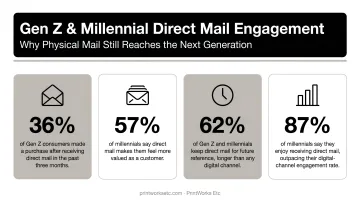
In healthcare, where trust directly influences whether a patient books an appointment or chooses a provider, that credibility advantage is hard to replicate digitally.
Measurability Changes the ROI Conversation
Unlike a billboard or a broadcast ad, direct mail campaigns can be tracked with precision. Embed a unique QR code, a personalized URL (PURL), or a dedicated phone number in each piece, and every response ties back to the campaign.
That data makes it possible to calculate cost per acquisition, compare response rates across audience segments, and defend the spend — something most traditional channels can't offer.
What Makes Healthcare Direct Mail Unique: Compliance, Sensitivity, and Trust
Healthcare direct mail isn't retail direct mail with a medical logo. The content often involves sensitive health information, the tone has to be empathetic rather than salesy, and the entire process — from how patient data is accessed to how the final piece is delivered — operates under federal privacy law.
Navigating HIPAA in Direct Mail Campaigns
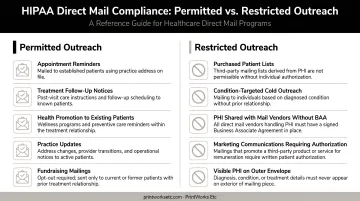
According to HHS guidance on marketing, healthcare organizations generally must obtain written patient authorization before using Protected Health Information (PHI) for marketing purposes. There are exceptions — communications about the covered entity's own health-related services, treatment-related communications, and care coordination don't require authorization — but using PHI to market products or services without consent is a HIPAA violation.
For direct mail, this creates a clear operational boundary:
- Permissible without authorization: General service announcements, new patient welcome mailers, community health awareness campaigns, seasonal care reminders sent to geographic audiences
- Requires patient authorization: Condition-specific outreach that references a patient's diagnosis, treatment history, or health status
Any vendor that creates, receives, maintains, or transmits PHI on behalf of a covered entity is a Business Associate under HIPAA and must sign a Business Associate Agreement (BAA). That includes print vendors handling patient list data. Note: mail carriers like USPS are treated as conduits and generally don't require BAAs — but the print shop processing the data does.
Criminal penalties for HIPAA violations range from $50,000 and one year imprisonment for knowing violations up to $250,000 and ten years for violations involving intent to sell or exploit PHI, per DOJ enforcement guidelines. Civil penalties follow a tiered structure updated annually.
When vetting a print vendor for healthcare campaigns, confirm they can sign a BAA and explain how PHI is handled — or avoided — throughout production.
PrintWorks Etc works with hospice, palliative care, hospitals, medical practices, and behavioral health clients on print production built so that no PHI appears in templates, keeping the production workflow compliant from the start.
Patient Segmentation Without Compromising Privacy
Understanding HIPAA's boundaries doesn't mean limiting your reach — it means targeting smarter. Strong segmentation is achievable without touching PHI:
- Geography: Target households within a defined radius of a new clinic location
- Demographics: Age-specific outreach for preventive screenings or Medicare enrollment windows
- New movers: Households that recently relocated into a zip code are prime targets for new patient welcome campaigns
- Insurance type: Available through third-party data providers without requiring individual patient records
The practical rule: if you're mailing to a general audience based on demographic or geographic criteria, you're operating without PHI and within clear compliance boundaries. If you're referencing a specific patient's health condition or history in the piece, that requires explicit consent.
Types of Direct Mail Pieces That Perform Best in Healthcare
Format choice in healthcare direct mail affects more than aesthetics. It shapes deliverability, open rates, and whether the piece feels appropriate for its content.
| Format | Best Use Case | Sensitivity Level |
|---|---|---|
| Sealed envelope letter | Billing, clinical notifications, formal follow-ups | High |
| Standard postcard | Seasonal reminders, flu shots, service announcements | Low |
| Oversized postcard | New patient acquisition, event promotion | Low–Medium |
| Trifold/bifold mailer | Patient education, multi-service highlights | Medium |
| Dimensional mailer | New patient welcome kits, high-priority outreach | Medium |
Trigger-Based Mail Outperforms Batch Campaigns
The highest-performing healthcare direct mail tends to be event-driven rather than calendar-scheduled. A piece that arrives because something relevant happened — a patient's annual checkup window, a new practice opening nearby, a post-appointment follow-up — feels timely. A generic seasonal mailing to the same list every quarter feels routine.
Effective trigger-based formats include:
- New patient welcome kits sent after a first appointment
- Preventive care reminders tied to age milestones (mammogram at 40, colonoscopy at 45)
- Post-discharge follow-up letters that reinforce care instructions and next steps
- Appointment confirmation postcards that reduce no-show rates
Print Quality Is Part of the Message
In healthcare, a poorly printed piece signals carelessness. A provider that sends smudged postcards on flimsy stock undermines its own credibility before the recipient reads a word. Quality print production — accurate colors, clean typography, appropriate paper weight — communicates that an organization takes its communications seriously.
PrintWorks Etc handles Pantone/CMYK color accuracy, paper specification, and finish selection for healthcare direct mail — coordinating proofing and production so materials consistently meet brand standards before they reach patients.
How to Build and Launch a Healthcare Direct Mail Campaign
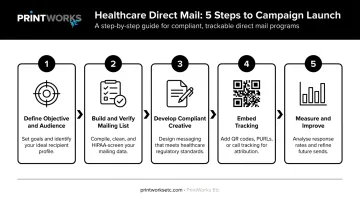
Step 1: Define One Objective and One Audience
Every campaign should start with a single, specific goal. New patient acquisition requires a different message, format, and call to action than appointment reactivation or community health awareness. Define both before touching creative.
Step 2: Build and Verify Your Mailing List
Sources for healthcare mailing lists include:
- Internal patient databases (with appropriate consent and compliance review)
- Third-party demographic lists (new movers, age-specific households, geographic targeting)
- EDDM (Every Door Direct Mail) for proximity-based saturation without a named list
Address hygiene is non-negotiable. USPS CASS certification standardizes address formats and delivery codes. NCOALink processes moves against a dataset of approximately 160 million change-of-address records, covering update windows of 18 to 48 months.
Skipping these steps wastes budget on undeliverable mail. In healthcare, a piece reaching a former resident's address can also create a compliance exposure — not just a bounce.
Step 3: Develop Compliant, Clear Creative
Effective healthcare direct mail creative has a few consistent characteristics:
- Headline states the benefit or action in plain language — no jargon
- Tone is empathetic: not clinical, not salesy, not alarmist
- One call to action only (one phone number, one QR code, or one URL)
- Layout uses enough white space that the piece doesn't feel cluttered
- All content reviewed for HIPAA compliance before going to print
Step 4: Embed Tracking Before You Send
Tracking transforms direct mail from a spend line into a measurable channel. Before printing, assign:
- A unique QR code that links to a campaign-specific landing page
- A PURL (personalized URL) for variable data campaigns
- A dedicated phone number that routes through call tracking
These mechanisms give you hard response data — response volume, source attribution, and cost per acquisition — that make the ROI case concrete when budget reviews come around.
Step 5: Measure, Then Improve
Track these metrics after each campaign:
- Response rate (total responses ÷ total pieces mailed)
- Conversion rate (appointments booked, services requested)
- Cost per acquisition
- ROI (revenue attributed to campaign ÷ total spend)
Direct mail programs improve with repetition. The first campaign sets your baseline numbers. By the second or third send — with adjusted targeting, refined messaging, or a different format — response rates typically climb and cost per acquisition drops. Document every variable you change so you know what's actually driving the improvement.
Integrating Direct Mail with Your Digital Marketing Strategy
Direct mail is effective on its own. As part of a coordinated campaign, though, it compounds the impact of every other channel it works alongside.
USPS reported in May 2025 that adding direct mail to its own digital campaigns caused overall revenue to more than double. That's an internal USPS example, not a healthcare benchmark — but it illustrates what happens when channels reinforce each other rather than operate in parallel.
Practical Integration Tactics for Healthcare
- Send a postcard reminder two weeks out, then follow with an SMS confirmation three days before the appointment
- Include a QR code on new service announcements that links to a provider video or virtual tour
- Time the postcard to arrive midweek, with a follow-up email going out the same week carrying the same call to action
- Drive wellness campaign recipients to an online self-screening tool directly from the mailer
Each touchpoint reinforces the message. Patients who see the same communication across multiple formats are more likely to act than those who see it once.
That consistency matters even more as digital channels face growing restrictions. Direct mail holds a structural advantage that's easy to overlook until you're working around it.
The Privacy Argument for Direct Mail
Digital advertising is becoming less reliable as a compliant channel. IAB's 2024 State of Data report found that 95% of data and advertising decision-makers expect continued legislation and signal loss, 72% anticipate reduced ability to use or access PII in digital channels, and 71% are actively expanding first-party datasets in response.
Direct mail doesn't depend on third-party tracking infrastructure, cookies, or pixel data. For healthcare marketers operating under HIPAA, a channel that runs on compliant first-party or non-PHI data is already a safer starting point. Add the fact that a physical piece can't be blocked by a spam filter or an ad blocker, and direct mail becomes structurally more durable than a digital-only strategy.
Frequently Asked Questions
How does HIPAA affect healthcare direct mail marketing?
HIPAA requires written patient authorization before using PHI for marketing purposes. General service mailings using non-PHI demographic data are permitted without authorization. Any print vendor that handles patient data must sign a Business Associate Agreement (BAA).
What response rate can healthcare providers expect from direct mail?
USPS health-sector data shows that healthcare direct mail most commonly generates 11%–15% response rates, with 16% of health businesses reporting rates above 25%. These figures vary based on audience quality, message relevance, and format.
When should a provider use a postcard versus a letter?
Postcards work well for non-sensitive, high-visibility messages like seasonal reminders or new service announcements. Sealed letters are the appropriate format for sensitive, detailed, or personalized communications — anything a patient shouldn't see before opening.
Can healthcare direct mail be personalized without violating patient privacy?
Yes, using non-PHI data such as name, address, age range, and location is generally permissible. Personalization that references a patient's specific diagnosis, condition, or treatment history requires explicit consent under HIPAA.
How much does a healthcare direct mail campaign typically cost?
Costs depend on list size, format, print quality, and postage. Main cost components include design, printing, postage (USPS Marketing Mail or First-Class), and list acquisition or hygiene — with campaign tracking via QR codes or PURLs adding measurable performance data.
Should healthcare providers use direct mail or email?
Both, used together. Direct mail delivers high-trust, high-visibility outreach that email can't replicate, while email provides low-cost, fast follow-up. Coordinating the two consistently outperforms either channel used alone.